
January 3, 2017 1:30 am
Are you thinking about studying abroad, but are not sure if it’s worth your time? Or are you ready to participate in a study abroad program, but need some extra talking points to convince your parents that you’ve made a smart decision?
The number of American students who go abroad has more than tripled in the past two decades (304,467 students in the 2013-2014 academic year), and this increase is likely to continue. International education is on the rise, and for good reason: research has shown that students who study abroad have better career prospects and are more socially aware. Read on to discover more study abroad statistics, facts, and figures that reflect the latest trends in international education.

For many years, the benefits of studying abroad have been described in words like these: “It will completely change your life!” and “You will come back a new person.” But the exact long-term benefits were unknown. Now, though, the positive impact of study abroad experiences can be proven with study abroad statistics.
The Institute for International Education of Students (IES) conducted a survey to explore the long-term impact of study abroad on the personal, professional, and academic lives of students. Here are some interesting findings:
One of the goals of study abroad programs is to train future global leaders who will respect other cultures and political and economic systems and care about the world’s welfare. The survey reveals that study abroad is succeeding in this mission:
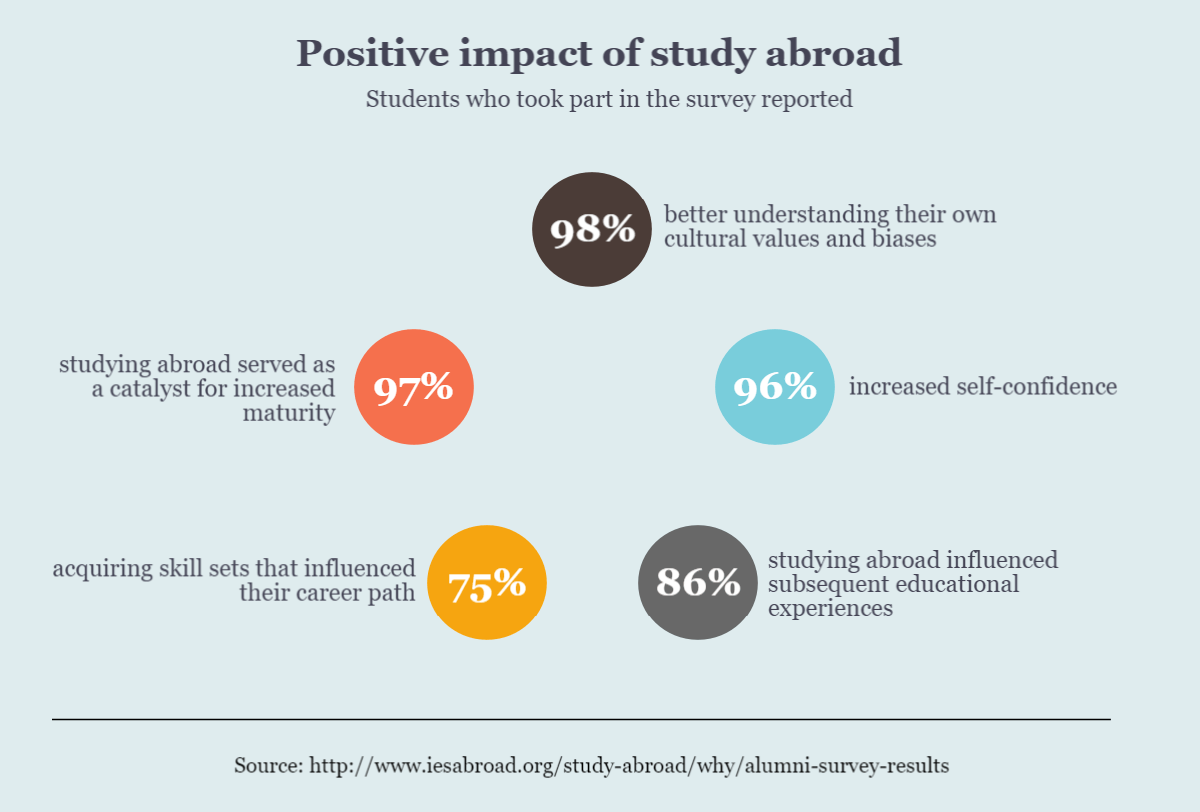
The survey results proved that studying abroad can greatly influence a student’s life. The results of the survey show that study abroad had a positive influence on the personal development, academic commitment, and career paths of the students who took part in IES study abroad programs.
Perhaps unsurprisingly, the results show that the longer students study abroad, the more significant the academic, cultural, and personal development benefits are. But the survey also suggests that study abroad programs lasting at least six weeks can also produce good academic, personal, career, and intercultural development outcomes.
The Erasmus Impact Study (2013) analyzed the effects of mobility on the skills and employability of students and on the internationalization of higher education institutions. The results of the study proved the benefits of studying abroad for the career development of mobile students. The study highlighted that mobile students are more likely to get managerial positions in their future careers and are less likely to experience long-term unemployment.
Here are some key findings.
Posted by deceptivelyblonde
Categories: Life
Tags: abroad, Study Abroad, Travel
Mobile Site | Full Site
Get a free blog at WordPress.com Theme: WordPress Mobile Edition by Alex King.