Archive | Study Abroad RSS feed for this section

Aer Lingus “Study in Ireland Program”

20 Jul

For my first return post, I thought I’d share a nice deal offered especially to Study Abroad Students!

According to their website, AerLingus (an Irish airline) is offering students studying in Ireland a special deal this summer through their “STUDY IN IRELAND Program.”

They’ll be offering “special airfares and a free date change to their return flight.” I like how it says you can change your return flight. Probably because so many students fall in love with Ireland and just want to stay a little bit longer (I know I did!).  Actually, it says you can even move the date of your return flight up (but who would want to?!?).  

The offer is for travel to or from Dublin or Shannon, Ireland on the following dates:

  • August 17-December 20, 2016 (Fall Semester)
  • January 6 – May 30, 2017 (Spring Semester)

Flights include those to/from Boston, Chicago, Hartford (as of Sept. 2016), Los Angeles, New York, Newark (as of Sept. 2016), Orlando, San Francisco, Toronto, and D.C.  Only individual students studying abroad get this special plan. 

However, the website also offers “special fares for Family & Friends Interested in travelling with or visiting the student while in Ireland (fares based on availability).” Awesome! Your best friend could come and visit you too!

For more details about the specifics and limitations, you can use the following resources:

If you try this program out, let us know how it goes! Excellent? Good? Bad? Terrible? Pass it on!

DISCLAIMER: This website is not affiliated with Aer Lingus in any way. My and my website are not responsible for anything AerLingus does or the program they are offering or anything else. I’m just letting you know what the website says.

“Report into study abroad students being radicalised”

25 Apr

Interesting. Hadn’t really thought much about this being an issue, but I can understand the concern. You would definitely want to be careful about your friends or acquaintances. If not because they’ll try to convert you, then simply that they might use an obvious traveler as an unwitting smuggler or transporter of goods. That’s always a problem (never carry something for someone you don’t know), but perhaps more so in countries currently involved in terrorist-like warfare. Students abroad are in a dangerous situation of being obviously naive, unfamiliar with local rules, and in a strange situation–it makes them vulnerable to being taken advantage of.**DB

Report into study abroad students being radicalised”

by Sudarto Svarnabhumi via “University World News

A number of Asian governments – among them Indonesia and Malaysia – are concerned their citizens who study abroad in the Middle East could become exposed to Islamic State doctrine, or, due to the proximity of Turkey to Islamic State strongholds in Syria, could be recruited from Turkey.

Reports from Jakarta, Indonesia, suggest students returning home from the Middle East have been monitored by the Indonesian government for evidence of radicalisation.

However, a wide-ranging study of Indonesian students studying in Egypt and Turkey over the past five years has found the students are not being radicalised, even though many of them, particularly those studying in Egypt, are religious students.

The just-released report by the Lowy Institute for International Policy in Australia in collaboration with the Institute for Policy Analysis of Conflict, Jakarta, examined the effect of political unrest in Egypt and Turkey, and the rise of Islamic State – variously known as ISIS, ISIL or Daesh – in Iraq and Syria on Indonesian students’ views on democracy, religion, political leadership and terrorism.

“Religion is only one criterion by which they [students] judge political events,” the report’s authors said.

“What came through in this study, in common with others [other studies], is that people are not radicalised, by and large, in the Middle East,” said Anthony Bubalo, deputy director of the Lowy Institute, launching the report in Sydney, Australia, on 15 April. “People tend to go to the institutions and study with Islamic scholars that reflect their existing outlooks in Indonesia. They are not suddenly exposed to extremist ideology.”

Students saw events in countries like Egypt – such as the overthrow of former president Mohamed Morsi in 2013 in what some called an ‘Islamist coup’ – as having “only limited relevance to the situation in their home country”, he said.

‘Firmly against IS’

Indonesia is particularly concerned about the threat from returning students, after major terrorist attacks by groups linked to al-Qaeda, notably the 2002 Bali bombing which killed over 200, including foreign tourists.

Islamic State claimed responsibility for a bomb attack on a shopping mall in Jakarta on 14 January that killed eight and injured two dozen.

From the research, and interviews with some 47 Indonesian students in Egypt – mainly at Al-Azhar University, an Islamic university in Cairo – and Turkey, “there was no sense at all that any of the Indonesian students would change the system they already have [in Indonesia] even though they were critical, in some cases, of the political system in Egypt”, said Sidney Jones, director of the Institute for Policy Analysis of Conflict, Jakarta.

The students interviewed were “very firmly against Islamic State”, she said, noting Indonesians known to have joined Islamic State had not come from universities and schools in the Middle East.

“Overwhelmingly the people that have joined [Islamic State] have come from Indonesia and not from studying abroad,” Jones said. . . .

READ MORE

International crises heighten study-abroad awareness

4 Apr

“International crises heighten study-abroad awareness”

by Vanessa Miller via “The Gazette

Today, it’s Belgium. Before, it was France.

There also is Brazil, where the Zika virus is rampant. And tomorrow could bring an earthquake, tsunami or hurricane somewhere else.

The drumbeat of terror attacks, health risks and natural disaster crises around the world has directors of growing university study-abroad programs continually monitoring international security updates and advisories. Program heads on Iowa’s campuses were paying attention Tuesday, for example, when news broke of more terror attacks — this time in Brussels.

None of Iowa’s three public universities have students studying abroad in Belgium right now, but Iowa State University — for one — has an exchange program planned there in spring 2017. ISU’s study abroad director, Trevor Nelson, said he doesn’t foresee Tuesday’s attacks derailing that program.

“But we have to monitor the situation and make the best determination about whether you are putting students in harm’s way,” he said. “At this point, I don’t believe we are in a position to put that program on hold.”

Nelson said study abroad programs these days have to be “more diligent in terms of monitoring what is happening in other parts of the world.” But, he said, that’s not necessarily indicative of a more dangerous international study environment.

Rather, he credited it — among other things — to a rise in students taking advantage of the opportunity.

“It’s partly a facet of the number of students who are now studying abroad,” he said. “And they are going to every continent.”

When Nelson started as the ISU study abroad director 25 years ago, about 200 students were involved. In the 2015 budget year, ISU sent 1,633 students oversees through a variety of study programs to every continent including Antarctica.

“And the type of students who are studying abroad has changed as well,” he said. “Twenty-five years ago, those who went on semester long programs tended to be self-starters and more independent and resilient than today.” . . . .

READ MORE

Texas Tech suspends Brussels study abroad programs

28 Mar

**They aren’t the only ones, some other colleges are backing out too. It’s up to you, just be safe! To be honest, I think we’re just as much in danger no matter where we are.  But I’m probably a bad person to give advice given my whole life is now spent abroad 🙂 ***DB

“Texas Tech suspends Brussels study abroad programs”

by Sara Dignan via “USA Today

A wreath is placed in front of the damaged Zaventem Airport terminal in Brussels on Wednesday, March 23, 2016. (Photo: Frederic Sierakowski, AP)

As the world mourns those who died and were injured in Tuesday’s terrorist attacks in Brussels, universities in the U.S. continue to work on strategies to keep students studying abroad as safe as possible.

And now one school, Texas Tech University, has decided the best recourse is to suspend its Belgium programs altogether.

The school announced that its summer and fall study abroad programs there have been canceled in light of the terrorist attacks that killed at least 30 people, says Elizabeth McDaniel, the school’s senior director for International Education.

“It’s the type of thing we are thinking about all the time, so it didn’t come as an, ‘Oh my gosh, we never thought this could possibly happen’ type of thing,” McDaniel says of Tuesday’s attacks. “Of course it has happened before and will likely happen again.”

Four Texas Tech students were in Brussels when the attack happened, but all are safe and accounted for, according to a report from KCBD.

McDaniel says the department is proactive in its safety measures for study abroad students, and that before venturing out of the country students must attend a two-hour safety seminar, where among other things they discuss potential terrorist attacks.

“We reevaluate safety measures every day based on what’s going on in the world,” McDaniel says. “We just look at the situation continuously and evaluate where our programs are going, where our students are going, and then make decisions accordingly.”

Texas Tech has study abroad programs in more than 70 countries. . . . .

READ MORE

Colleges With the Most Students Who Study Abroad

4 Mar

“Colleges With the Most Students Who Study Abroad”

by Delece Smith-Barrow via “US News

140918_widemodern.pitzercollege.jpg

The U.S. News Short List, separate from our overall rankings, is a regular series that magnifies individual data points in hopes of providing students and parents a way to find which undergraduate or graduate programs excel or have room to grow in specific areas. Be sure to explore The Short List: College, The Short List: Grad School and The Short List: Online Programs to find data that matter to you in your college or graduate school search.

More U.S. college students are packing their bags and heading abroad to complete some of their undergrad degree requirements.

The number of students studying abroad for credit during the 2013-2014 academic year grew 5.2 percent from the previous year, topping 300,000, according to NAFSA: Association of International Educators.

Studying overseas can be a great way to complete college coursework while also learning a new language and experiencing a different culture. At some schools, almost every undergrad studies abroad.

[See the 10 top destinations for U.S. students studying abroad.]

Goucher College in Maryland and Soka University of America in California, for example, require students to spend time overseas. At both of these schools, 100 percent of 2014 graduates studied abroad – the highest percentage among the 321 colleges and universities that submitted data to U.S. News in an annual survey.

Among the 12 schools where the highest percentage of students studied abroad, 10 are National Liberal Arts Colleges. These institutions emphasize undergraduate education and award at least half of their degrees in the liberal arts fields.

READ MORE

Rich students ‘five times more likely to study abroad’

2 Mar

“Rich students ‘five times more likely to study abroad’”

by Chris Havergal via “TIME’s Higher Education

Young woman seated in airport departure lounge

Undergraduates from the most affluent families are up to five times more likely to go abroad as part of their degree than less privileged students, a new study says.

Around one in 13 undergraduates (7.9 per cent) who graduated in 2013-14 and were from higher managerial and professional backgrounds went overseas to study, work or volunteer during their course, according to analysis of the Destinations of Leavers from Higher Education survey, compared with just 1.6 per cent of those whose parents were long-term unemployed.

The UK Higher Education International Unit, which conducted the research, found that the aggregated mobility rate for students from more disadvantaged backgrounds was 3.4 per cent, compared with the overall mean of 5.4 per cent.

There were also significant differences in participation by gender and by ethnicity. Female students were two and a half times more likely to go abroad than their male counterparts, and white undergraduates were around twice as likely to go abroad as their black and Asian peers.

These differences largely disappeared when language students, who account for 38 per cent of all international trips, were discounted.

However, the under-representation of students from less privileged backgrounds, and of black men, was unaffected.

The International Unit said the findings were concerning because, according to its analysis, students from disadvantaged backgrounds were among those who stood to gain the most from going abroad.

Five per cent of students from disadvantaged families who had an international experience were unemployed six months after graduation, compared with 6.2 per cent of less privileged students who did not go overseas, DLHE returns show.

READ MORE

Study Abroad Solution

29 Feb

“The Study-Abroad Solution”

by Sanford J. Ungar via “Foreign Affairs

In the Internet age, the world feels far smaller than it used to. But many Americans still know little about the rest of the world and may be more detached from it than ever. Such a lack of awareness is, in certain respects, understandable. Once the Cold War ended, some 25 years ago, Congress, perhaps out of a false sense of security, cut the foreign affairs budget, which led to the closing of some U.S. overseas posts. The news media, especially the commercial television networks, took their cue and began to reduce overseas coverage—responding, they said, to the decline of public interest in such matters, which conveniently coincided with their own economic woes. Although the 9/11 attacks and the subsequent wars in Afghanistan and Iraq stimulated renewed attention to international events, that phenomenon proved short-lived. Consequently, as new global challenges have arisen in recent years, American discourse on world affairs has lacked historical context or deeper understanding. It has become difficult to stir thoughtful, informed debate on foreign policy issues during congressional—or even presidential—campaigns. Many politicians who aspire to lead the country seem not to understand what constitutes a foreign policy issue, let alone the complexity of dealing with one. A candidate who speaks a foreign language appears almost suspect.

One symptom of Americans’ new isolation is a sharp contrast between the positive, even zealous views they hold of the United States and its role in the world and the anti-Americanism and negative perceptions of U.S. foreign . . . .

READ MORE

Student studies abroad three semesters, makes lifetime of memories

8 Feb

“Student studies abroad three semesters, makes lifetime of memories”

by Matthew McClure via “The Lamron”

Coming to Geneseo, I knew I wanted to study abroad for at least a year. I knew I wanted to go beyond my past linguistic and travel experience in Europe. This semester, I am returning from three semesters of studying abroad in Vietnam, Canada and Haiti. Study abroad has been an incredibly formative part of my undergraduate career—and my future plans—in both expected and unexpected ways.

The Global Service Learning Program in Borgne, Haiti proved to be a turning point for me. Through this program, I applied my interests in foreign language, intercultural competence and international education to connecting communities in Borgne and Geneseo. My experience in spring 2013 not only focused my academic interests, study abroad plans and career goals, but also had a lasting impact beyond that one semester. My service learning project became the design and organization of a Haitian Creole language preparation component for the course.

Immediately after the Global Service Learning Program, I knew I wanted to learn Haitian Creole and return to Borgne to help develop our program and relationship with the community. I traveled to Boston to attend the Haitian Creole Language and Culture Summer Institute, working with leading Haitian Creole scholars and collecting resources and teaching methods in order to help improve our Haitian Creole crash-course at Geneseo. As a result, I was selected to the Clinton Global Initiative University in 2015 to help support the first public library in Borgne.

In the fall of my junior year, I spent my first semester abroad in Vietnam. I went into the semester expecting a wildly new experience; one where I would learn an exotic new language. What I got was a semester where I was not only independent, but also the only native English speaker in my class. After learning Vietnamese, I could communicate with the locals and also speak to the internationals that spoke English. I met an extraordinary variety of people, both in Ho Chi Minh City and on my travels in Southeast Asia.

Perhaps the most surprising group I met in Vietnam was the Saigon Swing Cats. I had fallen in love with swing dance my freshman year, but I did not expect to find a club in Vietnam. It was a fascinating mix of locals and expatriates—mostly young professionals—gathering together to dance a vintage American dance. This is where I saw the overlap between my international interests and my dance interests. . . .

READ MORE

Where to Study Abroad? – 10 Things to Consider

29 Apr

DSC06306

Once you have made the important decision to study abroad, it is important to find the very best place for your dream adventure. Regardless of whether this is a once-in-a-lifetime trip or a one-in-a-billion trip, finding the ideal location is a big process.

But the world is large and glorious in all its wonder!

There are approximately 200 countries in the world, and almost all of them offer at least one collegiate institution for you to study in.  So many options, so little time!  It’s mind-boggling how study abroad can open your horizons and offer you the world on a silver platter.

So making that final decision of where to go can be a bit tricky and stressful. To help you out, I’ve talked with several study abroad students and drawn up a list of ten different considerations that can help you narrow down the choices.

Tag Archives: who makes more money

1. Money

It seems a bit petty, but money tends to be the first element worth considering when choosing your program. Studying abroad is hardly inexpensive, but some countries and cities can take less out of your bank than others.  For example, China and Korea have somewhat similar cultures and many similar programs; however, Tianjin is statistically cheaper by far than Seoul.  And Japan can run at New York costs if you stay very long.  So look at the cost of living for your country choices, not just the cost of tuition!
Map of Europe and European Political Map

2. Extended Travel

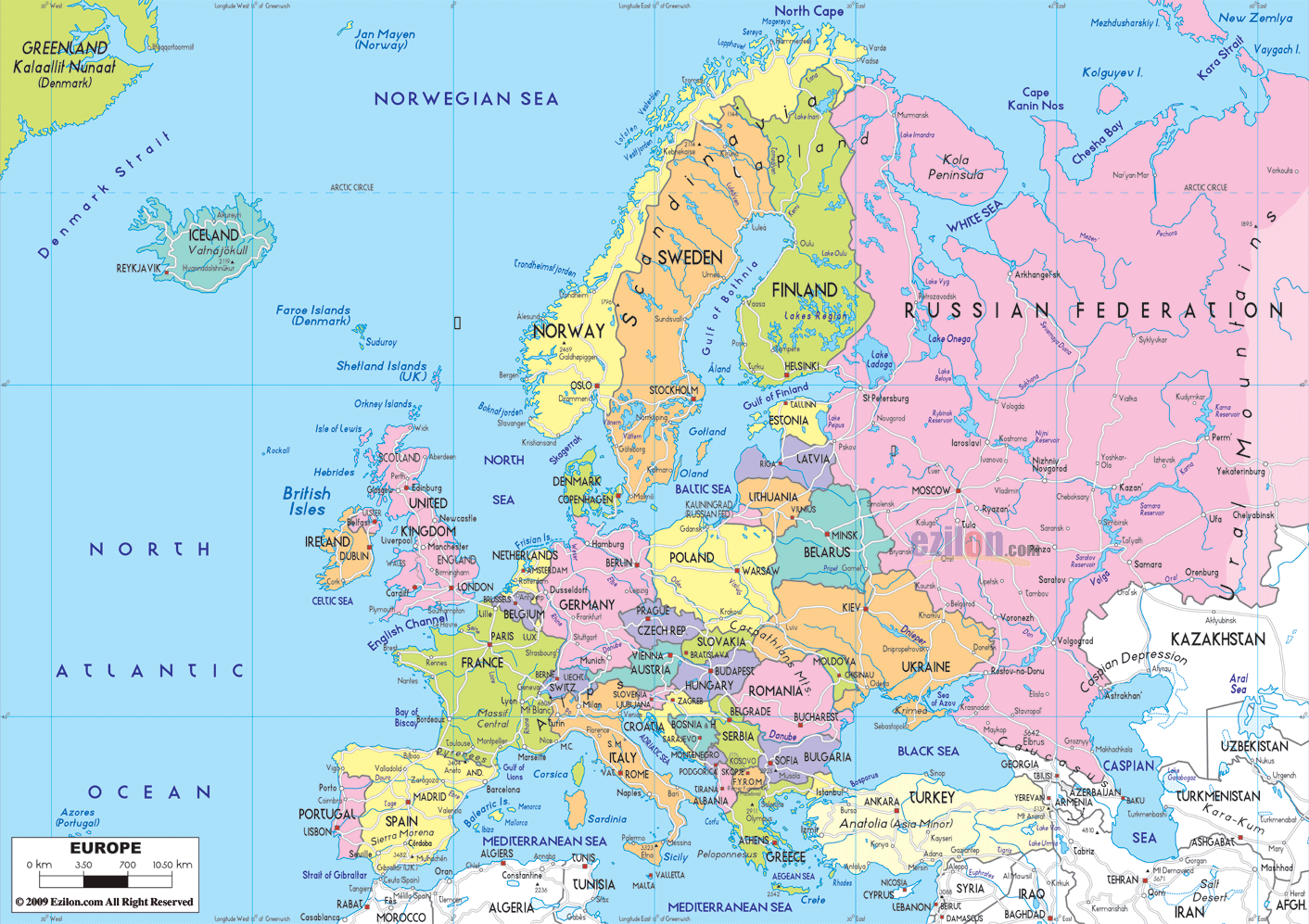
Some places make it easier than others to travel around a bit. People who travel to Europe are pretty free to hop on a train and set off all around the many nearby countries. The trip from Paris to Berlin in hardly worth mentioning, and maybe next weekend, you could pick up Spain or Switzerland?  South-East Asia is similar in some respects (Vietnam, Cambodia, Laos, China, India, etc.); however, keep in mind VISA costs and requirements.  On the other hand, Hawaii is a lovely state, but travel to other places is hardly easy. Same is true of most islands or isolated countries.  The middle of Russia is beautiful, but you’ve got a ways to travel to get out of it. Moscow on the other hand, might be a possibility.

world-map

3. Multiple Places?

Most students think of spending all their time with one program, but did you know it’s possible to do more than one if you plan it right? One summer, I picked up consecutive programs in Japan and China, spending the week in between relaxing in South Korea.  I carefully shopped around the different programs and found two that were close in time, but not overlapping.  Since I stayed in Asia, I wasn’t paying extra flight costs, it was just a matter of applying and being accepted to both programs. Think about the possibilities!

4. Extra-Curricular Activities

As I’ve said before, Study Abroad isn’t entirely about the program itself. Look into locations where you can pick up an internship or two. Maybe you know someone there who will give you a job or let you trail them at work.  Places where you can see some history and culture; watch some current major events; maybe even contribute some help of your own like a mission or volunteer program.

5. Career

Presumably, you picked study abroad because it will benefit your career in some way. Mostly for the fun sure, but there should be some small piece of you that’s hoping this will help your future. So think about places that will offer the most resources.  If you are interested in Asia-focused topics (languages, history, economy, government), then don’t look at European schools. On the other hand, if you are all about Brit lit, the EU system, the debt crisis in Greece, Renaissance art, etc. then maybe Europe is the place for you. Once again, think about places where you can get internships, visit relevant businesses, interview beneficial contacts, do some networking.

6. Language

This one is obvious, but worth noting — are you interested in learning a foreign language? If the answer is no, then stop. Go look at programs in countries that speak your language. There are tons of places that speak Chinese, French, English, Spanish, Arabic, etc. Just find one in your language and go with it. If language-learning is not part of your study abroad goals, then don’t bother with the stress.  On the other hand, if you think learning a foreign language will be helpful or you want the adventure, then stop looking at countries that speak your language and find one with a language that looks interesting to you. 

7. Program

Of course, you can’t forget to look at the program itself. In fact, it might be one of the first things to look at if it’s at all important to you. Despite what it seems like, study abroad programs aren’t all alike. There aren’t a million of every kind in every single country.  For example, I studied law, and there aren’t law school programs everywhere in Asia. I had to shop around before I found one in Korea at all. Options were very limited. Same is true of many other programs. Study abroad programs tend to be for the arts, business, or some sciences. Other programs, you may not have much of a choice. So before selecting the land of your dreams and getting your hopes up, make sure a program you need is available there.  

8. Time

How much time do you have to spend on this excursion? One week? Three weeks? Five months?  Trust me, you don’t want to waste your big opportunity spending a whole semester at a school in the middle of no-man’s-land with little means to get out. One week there, meeting the locals and becoming familiar with traditional customs? Might be a lot of fun!  If you have a lot of time, I recommend picking a place that has several nearby places you can visit that interest you.

9. Safety

Of course, keep in mind your own safety.  There are a lot of countries that I have always wanted to visit, but I really don’t think are safe right now. For example, I’ve always wanted to see the Sphinx and Pyramids and parts of Africa, but Egypt and Nigeria have had some problems. As a single, white Christian female, I may want to find a different country for now.  Or think about the places that are having bad disease outbreak.  Maybe there are places for you that are less safe than others; don’t risk your life recklessly just for a fun experience.

10. Dreams

Don’t forget to think about your dreams. If there is that one place that you’ve always wanted to check out, now would be the perfect time. I once visited China with a friend who can specifically to see Pandas in their natural habitat. She loved, breathed, and lived pandas, and this was just a major dream for her. Of course, the program was good for her too, but she really came for the pandas. And that’s okay too!

Life is about being happy, finding the things that light up your world, making a difference, and reaching the dreams that lay deep in your heart. Take this time as the opportunity to do that – find the place you love, that home away from home. And enjoy the heck out of it!

7 Tricks for Making Your Study Abroad Experience Pop

13 Mar
"In front of Pudong Skyline" by leniners

“In front of Pudong Skyline” by leniners

In 2012-2013, the United States saw 289,396 students studying abroad. (1) While that is still on 1% of the student body population, the number is ever increasing. Add to that the students and people who are traveling via vacations, volunteer missions, immigration, military, and other international-related events and you have a surprising number of people with experience travelling abroad. In fact, in 2012, one billion people travelled abroad as tourists, and that doesn’t include those who go on a different type of VISA, such as teaching or business.(2)  

Studying abroad is a highly advantageous experience; offering a wide number of benefits from increased confidence and self-determination to broader understanding of how the world works.  Still, perhaps the #1 reason why most students go abroad is the concept of resume-stuffing.  When launching ourselves into a new career, it can be difficult to stand out from the crowd; especially when most students have little practical work experience to fall back on.  Study abroad is one of the ways we give ourselves an edge over other candidates.

But now the word is out – Studying internationally offers excellent opportunities, builds your qualifications, and is fun to boot. So more and more people are joining the group of college and high schoolers stepping on planes  every summer, winter, spring, and fall.  

When the goal is to make yourself stand out, it’s starting to be more difficult to achieve this with study abroad. Too many people are doing it along with you. So how do you make your Study Abroad experience POP! What will help you rise above the crowd, pushing you in front once again?

1. Try a long Summer or Semester

Many programs in the Winter or Summer are actually pretty short. The two to three-week jaunt is pretty popular for universities, more like a small tour than classroom experience. While the shorter programs have a lot to offer (easy to fit into schedules, allows time for other experiences, lower costs), there is something to be said for taking a month or semester long program.  Attending a foreign university, taking actual classes with substantial assignments, getting more time to make the most of your trip and all the trip has to offer.  It will add to the legitimacy of you program in the eyes of Interviewers.

2. Step Out of Your Box

I say this quite frequently, but don’t just follow the program guide. Try planning your own adventures; adding friends or locals is even better. Too many students want to follow the schedule and then hang out at the hotel or nearby club. While the clubbing may certainly be fun; neither of those things adds to your hire-ability.  Instead, use the time to visit a museum, check out the main sights, try to get new and unique experiences. Feast at a random, untested food stall on the street. Go to an unmapped area in the city and wander the streets to see what you find. Employers who  look at study abroaders are significantly looking for people who show initiative, adventurousness, and adaptability. The best way to demonstrate that is to offer examples of times when you struck off the main roads and did something new and daring.  

3. Choose Well-Known Schools

One of the surprising things about Study Abroad is that it is usually easier to study with a reputable university for a short term than a long one. A lot of universities that would overlook you as a full-time student will gladly accept you as a student in their global program.  There is also the opportunity to pick a program at one of the hundreds of internationally recognized universities with ranking similar if not equal to US Ivy Schools. The international world of education has a lot to offer. Studying abroad is an easy way to study at a somewhat better (or more well-known) school than you otherwise might have.  

4. Pick Up a Internship

For some reason, most students don’t take internships into consideration when studying abroad. However, adding on work experience is one of the best ways to boost your resume.  You can find a lot of programs that offer an internship as part of the program itself (e.g. I studied with Fordham who organized a month-long internship with Samsung’s Legal Team in Seoul at the end of their summer program).  But you can also go out and find your own internship. Contact local companies; get ahold of your university’s career office and see if they have any contacts. 

5. Build Connections (and communication skills)

One of the worst mistakes Student Abroaders make is to hang out with fellow internationals and ignore opportunities to meet the locals.  It’s easier and more reassuring to sit and chat the night away with fellow English-Speaking members of your group than to stick yourself out there. But one of the skills to market to Employers on your return is that very skill – The ability to communicate with people regardless of background, culture, or language. Plus, you’d be amazed at the fascinating people you might meet! By opening up to the locals, you’ll meet expats who have had superstar careers or travelled to 150+ countries, local businessmen who own cool companies and invent awesome things,  maybe even some connections to help your career. Speaking of which, deliberately seek to meet and introduce yourself to people in your career field – ask for appointments, request interviews, and keep in touch with all the people you meet via LinkedIn or Email.

6. Take time on your Own

Having tested out several different types of study abroad programs, I found that the best and most beneficial experience were the trips I struck it off for a few days on my own. Maybe it’s just for a weekend trip from Madrid to Paris or jetsetting off for the holiday down to Shanghai. Or even just scooping out the little village an hour out. Planning and successfully completing a trip on your own in a foreign country is an amazing opportunity, and it grows you somehow. It doesn’t have to be expensive, but it shows you and your hirers that you have it to go. Dump you in a complex, difficult situation, and you can thrive. That’s not something a lot of students abroad do, but it sure helps you move out from the crowd.

7. Don’t slack on the Grades

Don’t use the study abroad trip as a chance to slack off and grab easy grades. Did you know that a lot of schools offer “Highest Grade in. . . . ” even for study abroad classes?  It looks great on your resume if you can grab something like that. Plus, this is a good chance to boost your grades since Study Abroad classes tend to be more laid back and relaxed.  Use this as a chance to show people that you can adapt and succeed in any situation, even classes in a totally different country, maybe in a second language.