
Once you have made the important decision to study abroad, it is important to find the very best place for your dream adventure. Regardless of whether this is a once-in-a-lifetime trip or a one-in-a-billion trip, finding the ideal location is a big process.
But the world is large and glorious in all its wonder!
There are approximately 200 countries in the world, and almost all of them offer at least one collegiate institution for you to study in. So many options, so little time! It’s mind-boggling how study abroad can open your horizons and offer you the world on a silver platter.
So making that final decision of where to go can be a bit tricky and stressful. To help you out, I’ve talked with several study abroad students and drawn up a list of ten different considerations that can help you narrow down the choices.

1. Money
It seems a bit petty, but money tends to be the first element worth considering when choosing your program. Studying abroad is hardly inexpensive, but some countries and cities can take less out of your bank than others. For example, China and Korea have somewhat similar cultures and many similar programs; however, Tianjin is statistically cheaper by far than Seoul. And Japan can run at New York costs if you stay very long. So look at the cost of living for your country choices, not just the cost of tuition!
2. Extended Travel
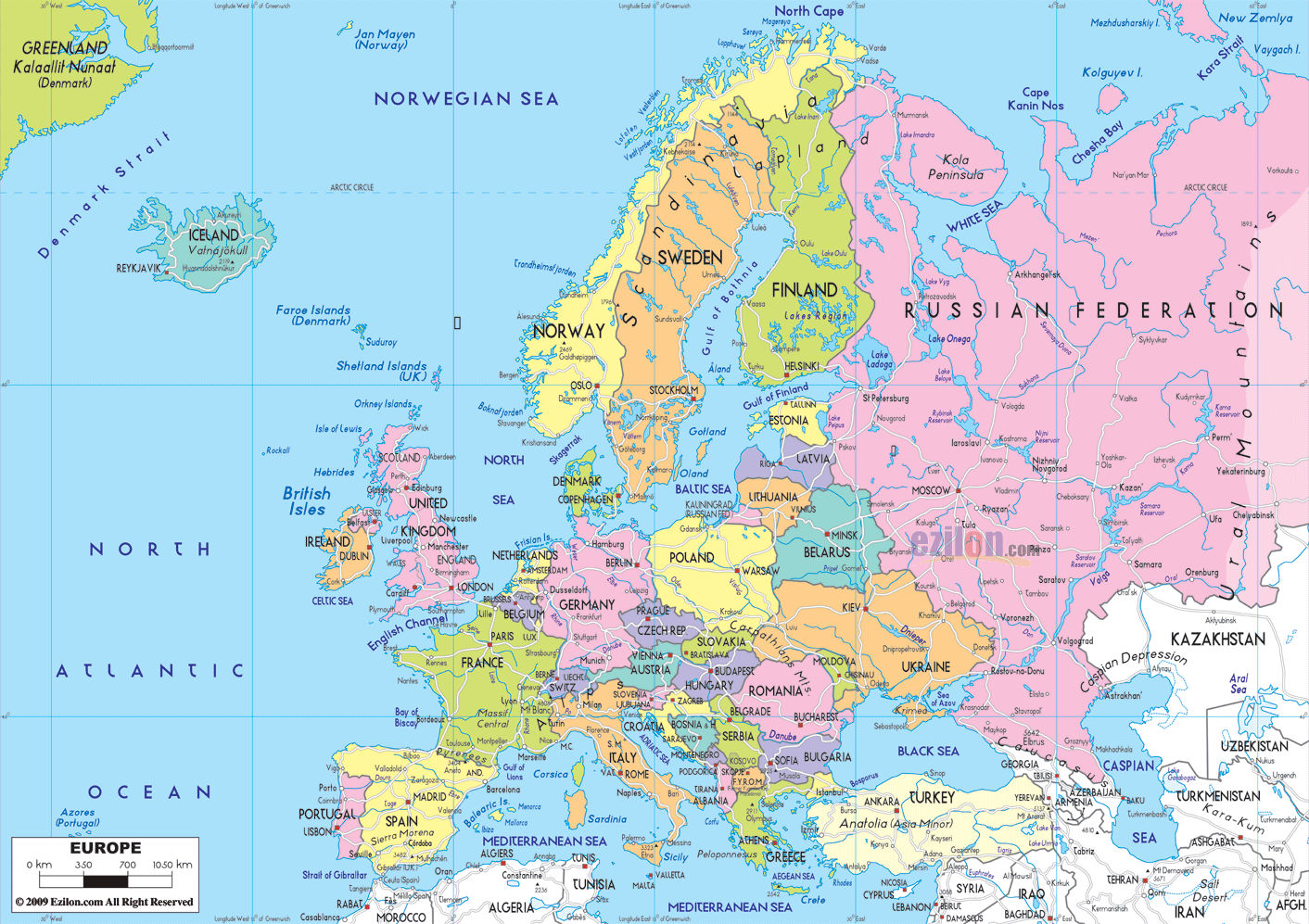
Some places make it easier than others to travel around a bit. People who travel to Europe are pretty free to hop on a train and set off all around the many nearby countries. The trip from Paris to Berlin in hardly worth mentioning, and maybe next weekend, you could pick up Spain or Switzerland? South-East Asia is similar in some respects (Vietnam, Cambodia, Laos, China, India, etc.); however, keep in mind VISA costs and requirements. On the other hand, Hawaii is a lovely state, but travel to other places is hardly easy. Same is true of most islands or isolated countries. The middle of Russia is beautiful, but you’ve got a ways to travel to get out of it. Moscow on the other hand, might be a possibility.

3. Multiple Places?
Most students think of spending all their time with one program, but did you know it’s possible to do more than one if you plan it right? One summer, I picked up consecutive programs in Japan and China, spending the week in between relaxing in South Korea. I carefully shopped around the different programs and found two that were close in time, but not overlapping. Since I stayed in Asia, I wasn’t paying extra flight costs, it was just a matter of applying and being accepted to both programs. Think about the possibilities!

4. Extra-Curricular Activities
As I’ve said before, Study Abroad isn’t entirely about the program itself. Look into locations where you can pick up an internship or two. Maybe you know someone there who will give you a job or let you trail them at work. Places where you can see some history and culture; watch some current major events; maybe even contribute some help of your own like a mission or volunteer program.

5. Career
Presumably, you picked study abroad because it will benefit your career in some way. Mostly for the fun sure, but there should be some small piece of you that’s hoping this will help your future. So think about places that will offer the most resources. If you are interested in Asia-focused topics (languages, history, economy, government), then don’t look at European schools. On the other hand, if you are all about Brit lit, the EU system, the debt crisis in Greece, Renaissance art, etc. then maybe Europe is the place for you. Once again, think about places where you can get internships, visit relevant businesses, interview beneficial contacts, do some networking.

6. Language
This one is obvious, but worth noting — are you interested in learning a foreign language? If the answer is no, then stop. Go look at programs in countries that speak your language. There are tons of places that speak Chinese, French, English, Spanish, Arabic, etc. Just find one in your language and go with it. If language-learning is not part of your study abroad goals, then don’t bother with the stress. On the other hand, if you think learning a foreign language will be helpful or you want the adventure, then stop looking at countries that speak your language and find one with a language that looks interesting to you.

7. Program
Of course, you can’t forget to look at the program itself. In fact, it might be one of the first things to look at if it’s at all important to you. Despite what it seems like, study abroad programs aren’t all alike. There aren’t a million of every kind in every single country. For example, I studied law, and there aren’t law school programs everywhere in Asia. I had to shop around before I found one in Korea at all. Options were very limited. Same is true of many other programs. Study abroad programs tend to be for the arts, business, or some sciences. Other programs, you may not have much of a choice. So before selecting the land of your dreams and getting your hopes up, make sure a program you need is available there.

8. Time
How much time do you have to spend on this excursion? One week? Three weeks? Five months? Trust me, you don’t want to waste your big opportunity spending a whole semester at a school in the middle of no-man’s-land with little means to get out. One week there, meeting the locals and becoming familiar with traditional customs? Might be a lot of fun! If you have a lot of time, I recommend picking a place that has several nearby places you can visit that interest you.

9. Safety
Of course, keep in mind your own safety. There are a lot of countries that I have always wanted to visit, but I really don’t think are safe right now. For example, I’ve always wanted to see the Sphinx and Pyramids and parts of Africa, but Egypt and Nigeria have had some problems. As a single, white Christian female, I may want to find a different country for now. Or think about the places that are having bad disease outbreak. Maybe there are places for you that are less safe than others; don’t risk your life recklessly just for a fun experience.

10. Dreams
Don’t forget to think about your dreams. If there is that one place that you’ve always wanted to check out, now would be the perfect time. I once visited China with a friend who can specifically to see Pandas in their natural habitat. She loved, breathed, and lived pandas, and this was just a major dream for her. Of course, the program was good for her too, but she really came for the pandas. And that’s okay too!
Life is about being happy, finding the things that light up your world, making a difference, and reaching the dreams that lay deep in your heart. Take this time as the opportunity to do that – find the place you love, that home away from home. And enjoy the heck out of it!
Tags: Career, Countries, country, Location, Study Abroad, Travel, Where to Go













 Deceptively Blonde