
Tag Archives: legal

When the State Drops The Ball

6 May

I just received an update from my Young Lawyers Division – Iowa’s House has (apparently without much warning) approved a bill that drops the salary of lawyers doing criminal defense work for the state – from $60/hr to $25/hr. (See  SF 497).

For those unfamiliar with the legal system of America, the 6th Amendment states that criminal defendants (people accused of a crime) have the right to an attorney. 

You’ve heard the Miranda Rights given on TV – “You have the right to an attorney. If you cannot afford one, one will be provided for you.”  Good old Law & Order, coming through once again!

So, if you have the right to an attorney but a serious lack of money, who does this “providing of lawyers”? — In short, the state courts do.  

There are a whole series of lawyers who take on work from the state defending the accused criminals who cannot afford a lawyer on their own.  These lawyers are often young, self-employed, looking for experience, and desperate for money to pay the bills until they get a job with an official firm. 

It is with this understanding that the problem with the salary decrease become apparent.  These lawyers already have a hard time affording the legal costs at $60/hr.  

Last year, I worked with a Solo Practitioner doing this type of work for the state.  The costs (gas, printing, filing fees, travel costs, lost profits, etc.) for the lawyers are ridiculously high in comparison with the salary.  Even at $60/hr, it is a struggle to make more than they spend doing the job.

Of course, the courts also have a maximum on the number of hours you can claim in the end, and that standard was consistently far lower than the time actually spent preparing and defending the case.  So, that same $60 (or $25 at the new rate) actually spreads out over more than an hour. It all adds up to a pretty penny.

Lawyers were already vastly unhappy with the 60$ an hour salary, and there has been significant clamoring for a raise for some time.  Instead, the House has gone the opposite direction. 

As someone with experience in this type of law, let me say, $25/hr isn’t going to come even close to cutting it. There is no way that will pay for all the losses the lawyers experience in doing the work. 

Naturally, the first response for the lawyers would be to refuse this type of work in the future.

Ah, but here we have a more significant problem – at what point is the State interfering with the 6th Amendment rights and Due Process?  By decreasing the salary so much that no one can afford to take on the work, they have taken away the lawyers for the criminal defendants.

The future in this situation is easily predictable – this would go one of three ways.  Naturally, as lawyers stop taking on the work, there will eventually come a time where there are not enough lawyers to handle the work-load.  Now, 1) the state will have to raise the salary to entice lawyers back, making the new bill pointless;  2) the state will have to set aside the defendant’s right to an attorney and begin holding trials without lawyers present (setting a frightening precedent); or 3) the state will have to  drag things out until the 1-2 lawyers who do this out of their own kind hearts have time to show up.  

Why do we even have this right to due process and a lawyer in the first place? As I told my Business Law students recently, there is a significant risk inherent in the criminal law system. A state-based judge handling a case brought by a state-attorney in the name of the state/local police = a criminal trial.  And the only person in this system that doesn’t know what the rules are or how to adequately handle the process is the defendant who’s life, liberty, and money are on the line.  

How is that fair in any way, shape, or form? Even my ESL students knew this answer – It’s not.  It’s a breeding ground for bad trials and problem of bias and corruption.  Thus, the law gives the defendant the right to an attorney. The right to a trained legal expert who knows what’s going on and what is the best defense to give. The right to someone there on your side, making sure the system is as fair as it can be.

By risking the possibility that lawyers won’t take on this kind of work, the State is risking the fact that the system isn’t going to work anymore. No lawyers means no right to an attorney. No right to an attorney means that an unprepared defendant is facing down highly trained legal experts from the state in a state-based trial system. It’s a situation just asking for inefficiency and unfair decisions to abound.  

Lawyers aren’t asking the state to pay out a fortune for this type of work, but neither can they afford to do the work when it costs more than they make.  Especially, the young solo practitioners who traditionally take on this type of work. It simply isn’t feasible.  $400/hr is not necessary, but enough to cover costs is.  And $25/hr simply isn’t it.
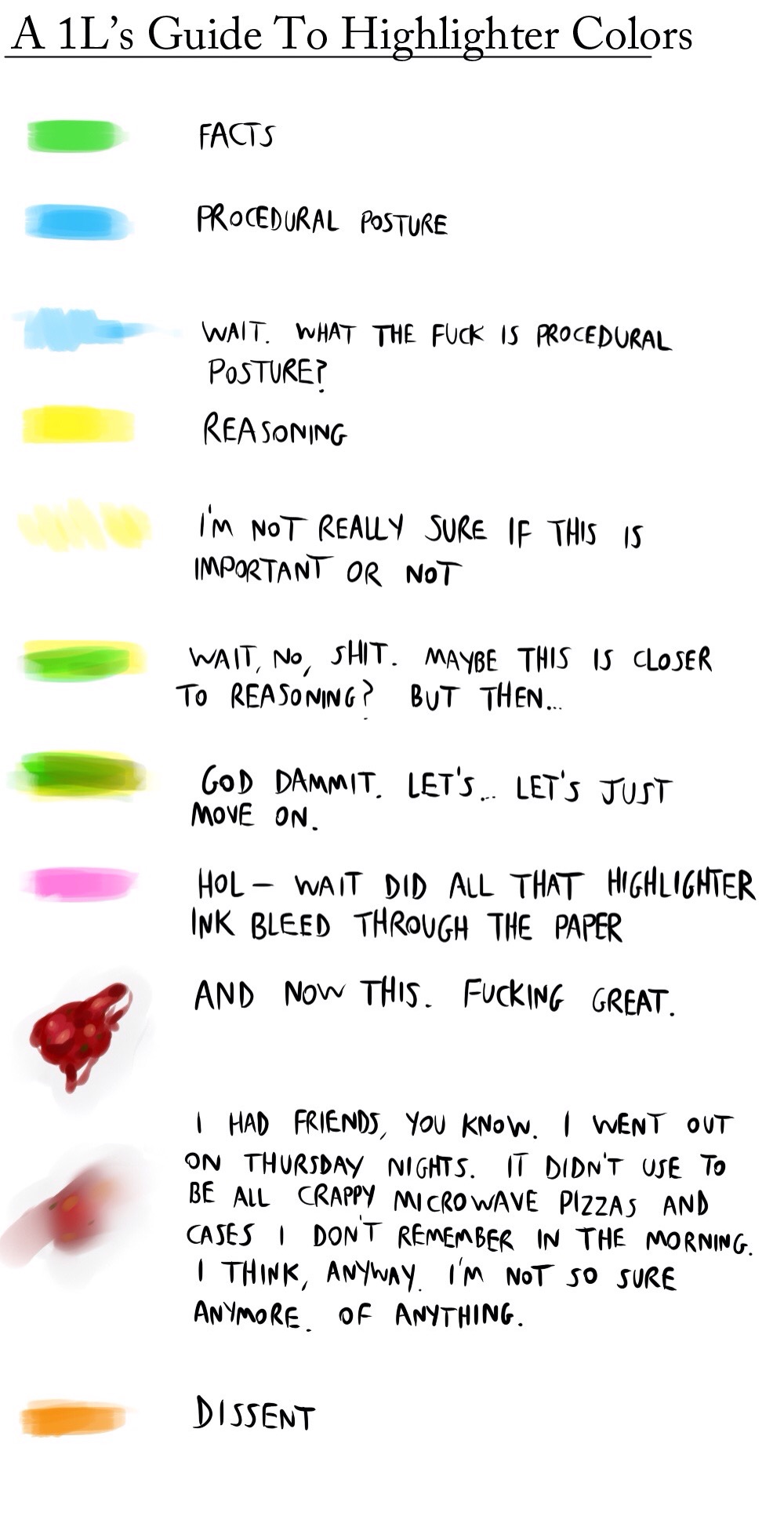


yes

25 Feb


from BitterLawyer


Bar Exam: MEE Review

26 Feb

MEE (9:00-12:00 & 1:30-4:45) on Day 3

Meh, mixed reviews here people.  

It started out the same way as before, they read us the rules and handed out the tests.  You had to have the white card especially today, since the NCBE # and your Applicant # had to go on the bubble answer sheets. We filled that out, and the process started.

You’re given 100 questions for both 3 hour tests, resulting in 200 questions over all. They are all multiple choice, and covered Property, Evidence, Criminal Law, Constitutional Law, Contracts, and Torts.  They were fairly well divided, although I though a lot of the questions were repeats of subjects (you know, repeat the same question in a different format?).  I think I did better on this portion.

The worst part was the tediousness–by question 80, I was bored out of my mind with those types of questions.  Reading the answers and questions over and over, you fall into a rut. Some people worked until the very end, but everyone in my row and the rows in front of me were done well ahead of time.  I finished 20 minutes ahead of time for the first portion and 30 minutes ahead of time for the second portion. Of course, I never gave it a second run-through.  I hate second guessing myself, I generally second guess wrong.  😛  I gave it my best shot the first time and then sat and tried to cool down.  

Best Method of Answering

Follow Barbri’s recommended method. Read the answers first, mark the ones you know are wrong. Next read the call of the question, can you check off anything else? Finally read through the facts.   The hardest part is falling into a rut and moving too quickly when you realize time is disappearing. It can be easy to start moving faster and missing things when you have this many questions. I try to stop and take a 1 minute break every hour. Sit back, breathe, and re-focus your mind, then tackle the next 34 questions.  

Ease Measure: Medium

Bar Exam: MBE Review

25 Feb

MBE (1:30-4:45) on Day 2

Okay. . . this was MUCH worse than I had hoped.  We had one hour for lunch and then we went through the same intro process again.  FYI, to go to the restroom, you have to raise your hand, hide your test in Examsoft, put your files at the front, and go one at a time. Once again they give you all of the questions at once for the exam. All together you have 3 hours to do 6 essay questions.  They can cover any number of topics; the list is fairly broad. I was a little upset on this one–it seemed like almost everything showed up.  It seemed like most of the questions were on obscure subjects from the law.  Not my favorite exam; I definitely was prepared less for this than for the MPT.

I’ll go on the record with saying that I was unaware of the answer to the first 4 essays at all. I had to get to Question 5 before I recognized anything.  But it wasn’t that bad. If you read through the questions and think about what problem they are suggesting arises, you’ll hit quite a few points even if you lack the law. Think back to the original principles!

Best Method of Answering

Read all the questions (not the facts), and guess where the essay is going to fall. Then approach your best ones with 30 minutes each. Then hit up the harder ones with 20 minutes each. This leaves you time at the end to pick and choose which ones to flesh out. Honestly, you write a lot less than  you think from the practice exams. The questions are 1-1 & 1/2 pages, so reading can take a while.  Don’t bother with code sections; just run with what you have. If you don’t know the answer, go with common sense.  WATCH YOUR TIME

Ease Measure: Very Difficult

Bar Exam: MPT Review

25 Feb

MPT (9:00-12:10) on Day 2

Definitely not as bad as I was afraid of.  We arrived for the morning section and filled out the little signature cards. The room opened at 8:30 for those with laptops, so I went ahead and set up.  They gave out the instructions and began; don’t forget that by the time they finish instructions, you will be starting a little late.

The MPT rules explain the many different ways that the exam can be structured; however there is a general format. Traditionally, there will be two parts–the file and the library. The file has the facts; the Library has the law.  This is just a test on your writing skills; can you write an intelligent, well-thought response to the question. The questions come in many forms, and often a rarer form is thrown in to trip you up.  But it seems from the state’s list of “percentage likelihood that something shows up” information that some form of brief or memorandum are the most common.  The law can contain cases or code sections; often one of each. Each document has something worth noticing.  The facts will have a short summary with the question, followed by supporting documents.

One came with instructions on the layout of the test, but the other did not. In general, I’d say remember to always add the To, From, Date, RE section.  DON’T FORGET THAT YOU DO NOT USE YOUR KNOWLEDGE OF THE LAW.  Any statutes will be provided; it is set in a fake jurisdiction.

Best Method of Answering

My recommendation is to start with the law.  Type it up verbatim on your computer along with citations.  Then read the call of the questions. Lay out the law out in the pattern of the issues raised in the questions.  Then fill it in with facts as you read about them. Save 5 minutes for smoothing out the sentences.

Easy Measure: Very Easy

Bar Exam Review: Orientation

24 Feb

Woot! Day 1 of the Bar Exam is officially over!

As most of you already know, I’m taking the Iowa Bar Exam. It’s officially scheduled for the 24th through the 26th, but day one is just orientation. They required that we arrive by 12:45, and then orientation started at 1:00.  I kind of expected more of a meet & greet, but it was actually just rules and regulations.

I arrived a little early, and there was a lovely group of girls waiting around. We all chatted about the exam and our strengths/weaknesses. Amusingly, we were all dreading the essays, but on different subjects. I freely admit that BA is worrying me a bit. I rock at contracts, but BA is a little weaker right now.  Still, rumor has it that Family Law is the most common arrival, so I’ll be preparing extra for that one in review tonight. 

Upon entering the room, it was pretty packed. Apparently there is enough space for us all to be together taking the MBE, but I think it’ll be around 80-120 students?  I’m kind of a bad judge on that stuff.  

Upon arrival, they went through three different speakers. Two were mostly motivational speakers; telling us to eat and quit stressing. They only took up about 15 minutes. The third went over all of the rules–what to bring (pencils, highlighter, wallet); what not to bring (anything electronic; bags; purses; hoodies; mechanical pencils); when to arrive (30 minutes for laptopers; 15 for handwritten exams).  That took another 20 minutes, and really covered the material in the pamphlet sent to us in the mail.  Funny how they trust us to pass an exam, but not to read the directions.  

The worst & most tedious was registration.  They went row by row, and I was at the back, so I waiting another 30 minutes. You had to have 2 forms of identification, including one with a picture.  They handed each of us a small white post-card with a number on it. That is our ticket; required for each exam.  Apparently, tomorrow we’ll have to sign another card upon arrival and bring both into the room with us.

That really was the end. All in all, it took an hour and was pretty boring.  Still nice to meet people! Saw some from Florida and Minnesota getting their second bar licenses, and some 10 year grads just getting their first. 


Bar Exam Arrival

24 Feb

Lafayette I am here!  I was a little worried about getting here in the first place, with all the snow that keeps dropping on us. I’m getting a little tired of promises for no snow and sunny skies, then 6 inches in a neat pile 😛  Anyway, we got a pretty strongly worded warning this past week about anyone who fails to arrive on the basis of weather excuses. Apparently if you miss due to weather, they “will in fact be reporting your absence to any other bar you attempt to take, and it will have negative connotations.”  I kid you not. . . They’re just lucky no one died trying to drive in dangerous conditions just to save their career. Surely there is liability somewhere in there?

Anyway, we arrived safely!  Apparently that was a godsend, since I found out where I arrived that the vehicle was “unfit” for driving!  Talk about a stressor; the mechanics failed to tighten the lug nuts last time they rotated the tires and it ruined 4 tires, a rim, and the sensor.  Not the happiest of moments 🙂 The wheels are so bad, that the new mechanic said it was technically illegal to drive on them.  Who knew there was a law about that?  This doesn’t bode well for the test! 😛

Map of States Requiring Standardized Law Tests

10 Dec

The NCBEX offers the map of the US states and territories that use the NCBE exams. These include the MPRE, MBE, MPT, and MEE.  You can see which of these tests are used in which locations. Kind of helpful when choosing which state to bar into.


Maryland Bar Results July 2013

1 Nov

Maryland’s Bar Exam Results are out for July 2013! You can check your (or your friend’s) results here.  Congratulations to those who succeeded; sympathies and hugs to those who didn’t get better news.  Unfortunately, it only lists the people by Seat Number. Wishing you the best of luck!


Academic Tools Law Students Should Know: Commercial Study Aids

25 Aug

The others in this series are (in order):

Law School is starting, has started, or will start for all those newbie 1Ls who are arriving on the scene. On behalf of all of your seniors, I offer you welcome. To HELL. Okay, so I promise it won’t be like that forever, but the first few weeks are probably going to seem like you have entered the ninth level of Dante’s Horrors.  Or perhaps they’ll start you off really light and leave you unsuspecting only to be thoroughly traumatized by greater difficulties later in the semester.  So as a gift to you, I offer you a few tools that will help you on your way.  They won’t take all the agony out of the process, but hopefully it will lighten your load at least a bit.  I have at least 7 ready to post but I’m splitting them up for readability. The rest will come out staggered over the next few days. Good luck!

 Commercial Study Aids

You’re going to hear a lot of people talking about commercial study aids, and without an explanation they can be kind of confusing.  This title is given to a wide category of study guides published and sold by the major law-publishing companies. They can be everything from outlines to exam guides to flash cards and more.  Usually they are intended to help you study for exams or offer general overviews of major legal subject.  They won’t be specific to your professor, but they can help you better understand the topic when your prof goes off on tangents or just doesn’t explain himself/herself well.  Since there are hundreds Continue reading