

The Photo “Beyond Yonder Hills” was selected by Judges as a favorite, making it a winner of the Staff Winter Selection 2015!
The Photo “Beyond Yonder Hills” was selected by Judges as a favorite, making it a winner of the Staff Winter Selection 2015!

Where? ~ Kaifeng, Henan, China
How? ~ Fly into Zhengzhou (an international airport). Grab the train or a bus to Kaifeng (takes about 2 Hours)
Recommendation ~ Don’t go later in the winter than November 20th or so. All the cultural sites will be winding up their activities and events, so you’ll miss all the fun things to do there. For example, we caught the last showing of the Millennium Park War (a major thing to see).
Cost ~ Please note that the costs below are what was reported to me. To be honest, costs vary from week to week here. So it could be as much as 20CNY higher or lower (about $4) for each place, or it could be what I told you. It really depends on the day.

Why?
The Ancient City of Kaifeng 开封 (kI fuhng) lies in the heart of central Henan Province, China and trails just south of the Yellow River. The local Henan people speak of Kaifeng, the capital of six different dynasties and a town filled with beautiful flowers and famous dishes, with the greatest respect and awe.

“Open and Shut”
Dating to 364BC, a small city of canals and waterways linked to the Yellow River was created. This little town would eventually morph into a thriving business and merchant city, now home to almost 6 million people. The city would be destroyed, abandoned, and re-built many times in the following centuries, and remnants of these cultures can still be seen at the local cultural sites and the city museum. In fact, for about 114 years, Kaifeng was the largest city in the world! The tour guide compared it to Tokyo, New York, and Paris in its time.
The characters in the name Kaifeng represent the phrase “Open and Shut.” Officially, this name represents the fact that Kaifeng represents open and shutting doors. Kaifeng has always been open to new ideas, new theories ~ a center of business, technology, and politics. But it is also closed, remaining true to the traditional values and beliefs of its ancient inhabitants. This is why when you visit, you can find both Ancient villas that appear unmarked by the intervening centuries and modern Shopping.
Secretly, our guide says “Open and Shut” is the name because if you open up the windows in Kaifeng, you’re blown away by the winds. Perhaps true, it was seriously freezing and the wind could have cut through a sheet of glass. Continue reading
| G | J | J | T | C | E | N | N | R | V | T | A | E | H | L | N | X | T | E | T |
| U | F | O | P | N | K | D | E | E | Z | O | Y | U | T | U | H | Y | P | I | O |
| M | U | G | V | Y | R | C | D | H | Q | C | M | T | T | W | T | Y | P | U | H |
| P | C | N | O | R | Z | B | S | F | O | O | N | B | L | X | R | F | I | O | D |
| Z | A | D | E | B | B | N | C | O | W | O | S | P | O | B | G | O | T | V | A |
| P | L | N | M | I | D | K | K | M | A | A | P | Y | S | C | F | I | T | G | S |
| O | N | L | A | C | T | O | J | E | F | F | K | F | U | P | E | N | R | Z | K |
| X | K | K | N | P | H | U | I | M | Y | E | J | H | D | D | G | K | S | U | L |
| S | E | M | H | S | T | C | J | Z | D | G | D | U | G | W | M | Z | R | G | L |
| J | S | Z | C | C | C | Q | D | T | H | O | E | G | Z | W | Y | U | N | P | P |
| M | G | L | A | Z | G | H | U | N | T | E | C | B | U | O | N | W | B | A | W |
| Q | O | I | P | O | L | C | O | Q | A | L | M | Q | M | N | D | C | I | M | U |
| G | I | G | G | C | C | G | K | G | G | I | W | E | W | Y | N | V | Q | B | M |
| I | Z | M | W | K | M | Z | T | O | Z | D | H | Y | N | M | U | K | U | X | P |
| X | F | Y | X | Z | G | P | A | C | D | S | I | N | L | P | W | P | R | E | G |
| X | Q | T | F | H | X | E | H | Q | I | B | M | D | G | Y | W | A | N | G | U |
| H | O | M | G | J | P | V | N | E | T | J | C | O | F | A | T | M | B | I | B |
| R | P | X | I | I | D | T | N | T | H | V | D | V | H | J | R | E | H | D | D |
| H | E | N | D | E | J | F | G | A | Q | U | M | K | K | C | I | T | E | N | R |
| X | R | N | F | K | U | A | S | R | W | M | P | D | F | M | T | N | R | J | P |
| ACT | BED | BEG |
| BOP | BUG | BUM |
| COD | COT | CUT |
| DEN | DID | DIG |
| DIM | DIP | DOG |
| DUG | FAT | FED |
| FIT | GIG | GOT |
| GUM | GUN | HAT |
| HEN | HIM | HOG |
| HUM | HUT | JOG |
| LOG | LOP | MEN |
| MET | PAN | PEN |
| RAT | TAG | TIP |

This beautiful statue of the Buddhist Goddess of Mercy lies in Daxiangguo Temple in Kaifeng, Henan, China. Gold-plated, it is a memorial to both propriety and filial piety, two of the great Chinese Confucian virtues. The story below is a combination of the story told by the tour guide and some local conversationalists who were happy to relate the story to me.
Many centuries ago,
An old emperor of China grew very, very ill and saw that his country was suffering as well. Realizing that the country was troubled and needed heavenly assistance, the worried king called out to Buddha and asked for guidance on how to appease the heavens and reclaim the blessings from above.
Buddha responded that the country and its king had done some very wicked things in the past and that now a sacrifice would be required to repair the damage. Buddha asked that the Emperor offer up to the heavens one arm and one eye from someone within his family. If he did so, Buddhas said, the country and emperor would be healed and would live in peace once more.
The Emperor was very saddened and worried, because the only family he had left were his three young daughters. The Princesses though were very concerned about their father and finally convinced him to share what Buddha commanded. Upon hearing of the sacrifice required, the sisters were quite upset.
The eldest daughter went to her father ~ “My king, although I love you and would do anything else that you asked of me, I cannot do this for you. I am a new mother, my baby is still nursing. If I only have one arm and one eye, how could I possibly care for my baby the way a good mother is supposed to?” Continue reading
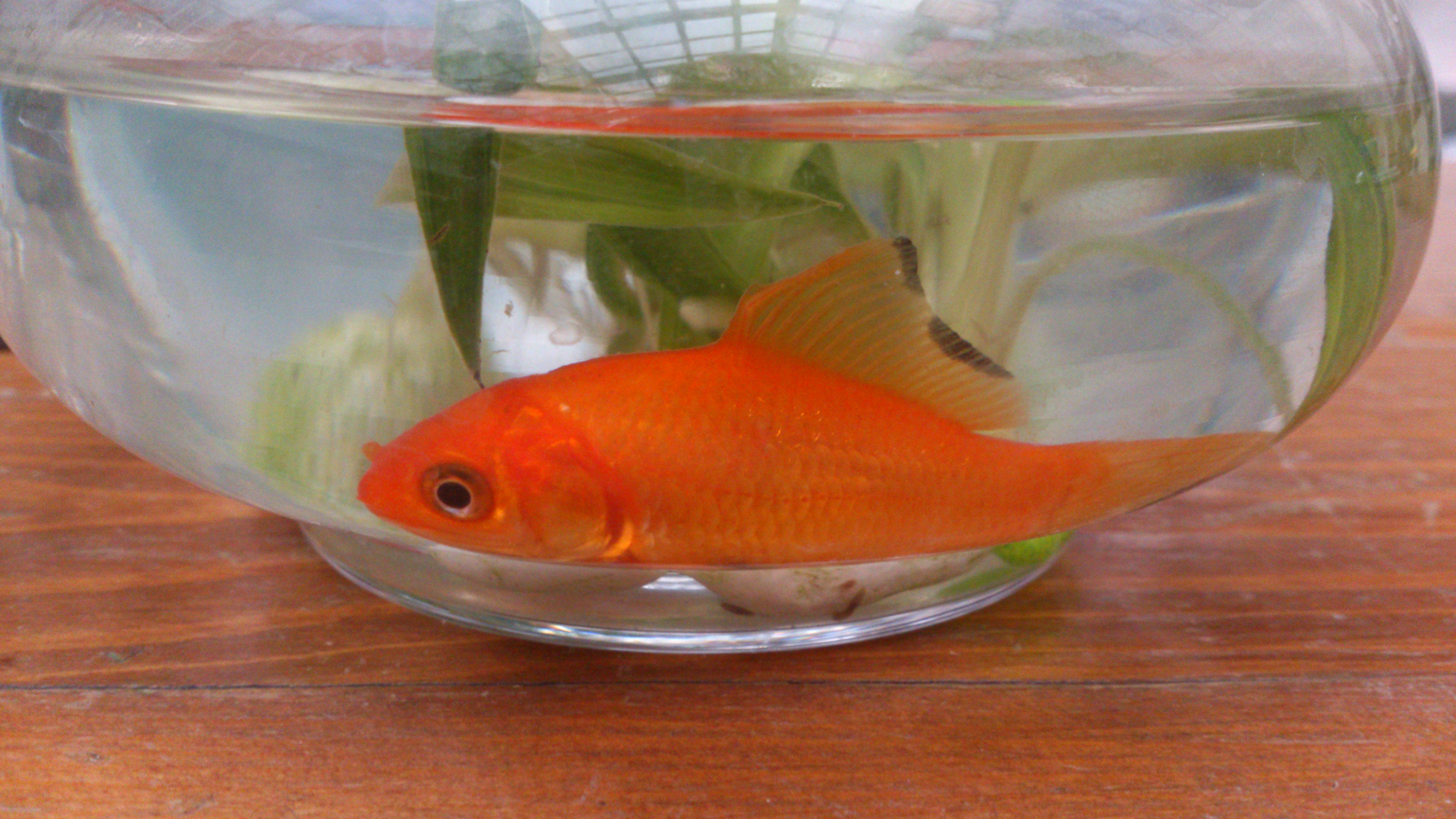
The local cafe has recently acquired a new employee devoted to customer happiness ~ Gordy, the resident Koi fish 🙂
Adorable little guy, he swims around in his bowl quite contentedly, entertaining children and adults alike.
Having attempted to keep koi fish myself and discovering a problem wherein they kept dying, I asked the owner how they have kept him alive so long.
One of the beauties of Chinese culture is how often they answer simple questions with ancient proverbs or philosophical explanations.
The owner’s enlightening response was that the key lay in finding moderation. The Koi fish are like people~they are a little strong and a little weak. They have particular environments that they need to survive. If it is too clean and easy, they will be lazy and unhealthy. If it is too dirty and difficult, they will be depressed and find it hard to breathe. They need balance to survive.
So every day, he changes Gordy’s water. But where I would change the water completely, they balance clean and dirty water. They dump out half of the old water and add half with new/fresh water. This way, the water is a lot like the local ponds that Gordy comes from ~ a little fresh water (from rain and connected waterways) and a little dirty water (from algae, dirt, and other natural dirtiers). In this natural environment, Gordy grows both strong and happy.
Go Gordy! Live Long and Prosper!

1) If you’re going try the exam again, that’s great. I wish you all the best and the truth is, practice makes perfect. The more you study, the more you practice, the better you will be on the actual exam! A lot of people take the exam and pass it on their second try. Many Bar Review programs will actually let you take the program again for free if you failed the exam the first time, so that fee isn’t going to be over your head. There are many people out there willing to tutor you in essay writing, in exam taking strategies, etc. You actually could probably hire a private Bar Tutor online or in your area. There are plenty of things you can do to improve your strategy. Obviously what you did the first time was insufficient, so do more. Try new techniques, find online support and practice groups, find new ways to learn the law. I honest-to-God learned a lot of Evidence/Criminal law by watching “Murder One”–where the people followed most of the rules of evidence/objections and I could see how the rules developed or worked. A lot of fiction books are written by lawyers, so maybe find a few that include the rules of law that you are working on.
One note of warning– you will do worse on your second exam if you don’t continue studying and reviewing in the interim. A lot of repeaters say, oh I did great on contracts, so I don’t need to study that anymore. This so wrong I can’t even tell you. Wait 6 months and try to remember all those contracts rules again, you’ll find they’ve already started fading into memory. So you really should continue reviewing EVERYTHING, not just the stuff you didn’t do so well on.
2) Finding an alternative law job is probably the most difficult option of all to accomplish. There are however, some types of jobs available to juris doctorates–even if some require additional training. For example, you could teach law (at home or abroad). The J.D. is technically a PhD, and there are several schools who won’t care about your bar scores as long as you can teach the topic. Now, teaching in America is probably more difficult, but there are a lot of schools internationally (High-school or College) that want professors of American Law. Or you could advertise your skills as a Consultant. This is sort of like a lawyer, except you aren’t doing any of the paper work, courtroom actions, etc. And you have to be upfront on the lack of a license. But you do have a PhD in Law (J.D.) and you are qualified to discuss the topics. Especially if you work in an alternative field and utilize the law as a supplement–work as a business consultant with the addition of a law degree. Paralegals are sometimes paid even more than lawyers, and that doesn’t require a law degree at all. Try out writing–many mystery writers start out as lawyers because they get experience in how criminal law works, maybe you could try your hand at it. You could try being an administrator. There are some organizations that want to hire people aware of the law, but don’t really care if you have a license or not. Try working as a legal researcher. A lot of lawyers and legal websites need legal research done for them–you don’t need a law license, you just need to understand the law. As you can see, there are several options available to you. I’ll try to pull together a list for you to use something in the future. But for now, try googling around for jobs requiring a J.D.
3) Actually, a lot of people who do pass the bar are going this route as well–finding a different path. This happens largely for two reasons–you aren’t good at law (let’s just agree that some people are not meant for the legal industry) or you generally dislike the field (it happens!). Law is never going to be a completely worthless degree. Businesspersons use it to create their contracts, protect their company, build start-ups, shutdowns, and more. Accountants use it to ensure they understand the field of banking/taxation and the rules that accompany those industries. Psychologists understand how to protect themselves and their patients. Politicians–well it’s obvious how they use the law. You get my point–you can do something completely different and still utilize your J.D.
But sometimes, the law field itself is just not going to work for you. Maybe you figure out after the 3rd or 4th try that you’re never going to get past the exam. Maybe you finally take the exam and realize that law sucks–it’s boring, takes a ton of hours out of your life, destroys families, the judges/legal systems are biased and unfair, etc. Some people take to the world of law like ducks to water. Others of us figure out that us practicing law is like a pussycat trying to be the champion diver in a competition field consisting of sharks. It just isn’t meant to be.
This is where my experience comes in. I actually passed the exam. I tried the law. I HATED it. Kudos to my friends who are extremely successful, but that was not going to be me. I could have been successful, but I figured out I didn’t really want to be–at least in that field. Now, have I abandoned my legal studies? NO! I am actually a law professor, legal researcher, and writer. I focus on the areas of law that actually interest me (Art Law & Cultural Heritage Law), rather than trying to force myself into a career as a Business lawyer or Family lawyer. I like teaching so much better–in fact, I’m getting ready to pursue a MA and PhD in English Literature, where I might be writing about Law in Literature.
If you are failing the exam over and over again, maybe you need to stop and think about your future. Is law really for you? Is the future you see yourself in really worth all this stress, aggravation, and money? I can’t promise you that once you get past the exam, everything will fall into place. If you had trouble memorizing and applying the civil procedure rules before the exam, you’re still going to have to do that in real life where the judges yell at you when you screw up. It’s not like passing the exam is a magic thing that means you’ll automatically be good at law for the rest of your life. No, you are still going to be tested on your law knowledge every time your stuff goes before a court.
So take a step back. Stop trying to force yourself into a bubble that you just aren’t fitting into. What is it that you actually like about law? Money? Maybe you’d be better off going back and getting an accounting, engineering, business degree. The learning? Teachers have a lot more learning time. Argumentation/Discussion? Writing, Politics, Teaching government, Creating government policy–all of those include persuasion and arguments. There are a lot of fields out there that will let you use your law degree while still being more successful at something you love. Yes, this may mean going back to school–and Lord knows, you’re tire of school. But most MAs take 1-2 years and can be shockingly affordable. A PhD may require 1-2 years of classes, but the rest is just writing your dissertation. It’s not like Law school, you can work your way through these programs. And some of your law classes might even transfer! See what I mean, you have options. Maybe the bar exam isn’t for you.

“She was free in her wildness. She was a wanderess, a drop of free water. She belonged to no man and to no city” ~ Roman Payne




Language Translation






 Deceptively Blonde