Archive | Asia RSS feed for this section

Life in China ~ Moving Money

21 Apr

Hello!

I’m back again with a little piece of life in China!  One of the significant issues confronting expats living abroad is the  matter of getting money back into the States.  

Whether it’s because you still have family at home, you want to put it in savings, or (like me) you have US/China bills to pay – almost everyone goes through the process of moving money from abroad back home or vice versa.

First things first, in China cash has three important vocabulary terms – Yuan, Jiao, and Renminbi.  Renminbi (RMB) is the official name of the currency, and if you want to exchange money to the US Dollar (USD), you need to know that RMB abbreviation.  We usually say “I need to exchange RMB to USD.” On the other hand, one Yuan ( ¥) is the most basic unit of money in China. In use, it is equivalent to our $1 bill although the exchange rate comes out very differently. Anyway, a bottle of soda here costs ¥3 which means three of the 1 Yuan bills (see above).  They also have bills of ¥5, ¥10, ¥20, ¥50, and ¥100. ¥100 is the highest possible bill you can use.  Finally, they have Jiao or fractions of a Yuan (10 Jiao, 5 Jiao, and 1 Jiao).  10 Jiao has the same value as ¥1, so we just call it 1 Yuan. 5 Jiao are 1/2 of a Yuan (i.e. 50 cents). 1 Jiao is 1/10 of a Yuan (i.e. 10 cents).  The Jiao either come in paper or coins. So we have Cash (Yuan ¥) and Fractions of a Yuan (Jiao) used in the daily, current Chinese currency or RMB.

In some countries, it is probably more simple than others to send money. Perhaps because China is a UnionPay Nation, it can be rather difficult here.  Union Pay is an alternative to VISA, Mastercard, ect. and is used in predominantly all Chinese banks.  Of course, the banks in China are a little different too.  For example, the bank card I was given does not include a security number or expiration date.And my phone number is 1***-****-****.  Note the extra digit in the middle.   So I have an incredibly difficult time using it online with American systems that require those details.  More and more US businesses are modifying their system to accept Union Pay cards, but the additional information required for many credit card entry systems does not always work.  

So how do we get our money from China into America? Currently, I have heard of four different primary methods or systems of transferring cash. One important factor is how much you need to exchange. Chinese nationals can exchange quite a bit more RMB to USD than foreign expats. Foreigners can only change $3000 a day. 

REQUIREMENTS / NOTES

To do any of this you should have a passport, valid Chinese VISA, a Chinese phone number, and your home address written in Chinese characters.

You also most likely need a Chinese bank account. There are many, many Chinese banks but only some of them work in the International Money Transferring business. For Paypal, only China Merchant’s Bank, ICBC, and China Construction Bank. For Bank-to-Bank transfers or Western Union transfers there are a larger group of banks, but still only the primary ones (i.e. Bank of China, China Construction Bank –I think you can only accept money, not send it though-, Agricultural Bank of China, etc.)  I recommend picking your method and then figuring out which type of bank account you need.

To open a Chinese bank account, you need to go during the work week (Monday-Friday) in order to get the right officials at the bank. The bank may be open on weekends, but the officials may not be there. I took a Chinese student and close friend with me. She had us bring our passports, VISAs, and recommended bringing a second photo ID like a driver’s license. We then went to the bank, filled out a lot of information on a form, and processed the account. Had to sign my name a couple times and then got my card.

I highly recommend that when you do this process you do a couple things to simply the process later. First, bring your Chinese phone number and add it to the forms so it is attached to your bank account. You will need this if you ever want to add Alipay, use Taobao, check your account online, etc. That phone number is one of the ways they verify that you own the account – they usually send a verification code by phone. Paypal verification process also sometimes requires that you accept the verification code by phone to enter it into the registration process.  Second, ask them to approve you for online banking and tell them you will use the card for online shopping. The Chinese translator can hep, but they have to actually approve you for using your card online or using it to pay for something. So go ahead and get that paperwork filed this first time.

BANK TO BANK TRANSFER

Many people simply use the Chinese bank itself to transfer money over to a US Bank.  Personally, I found it expensive and a bit of a hassle (especially since I work so much and getting to a bank with a Chinese student who can translate gets to be a problem). 

To do this, you need to bring them your Passport (and Visa) and the foreign bank’s name, mailing address, routing number, swift code, account number, etc.  You then probably need to bring a Chinese student with you to translate depending on where in China you are (Shanghai, they might speak English, but I’m in Henan where that ain’t happening).  It usually costs you a few hundred RMB on top of the exchange rate. Sometimes you have to exchange the money first and then transfer it. Sometimes they will do that for you. It depends.

BANK TO BANK VIA PAYPAL TRANSFER

This is the method I find simplest and most effective. It requires a series of steps, but once set up is extremely easy and cheap (4% fee). You can send up to $1000 a day and Paypal will do the currency exchange for you! To do this though, you will need two Paypal Accounts and two email addresses. 🙂 

Set Up

First, set up your US and China Bank Accounts. Make sure (as I said before) that the Chinese bank has approved you for online banking. China Merchant’s Bank, ICBC, and China Construction Bank are the only China Banks that this will work for!  In a safe location, keep track of your account numbers and the full and exact name that is on your Bank Account. This is very important especially for the Chinese bank because the name must be exactly the same or they will reject it.

Second, set up a Paypal Global Account and use one email address.   I recommend doing this with Google Chrome and then just right click on the page, hit “translate to English” and the Chinese will go away 🙂 Sign into the account and on the left click “Bank Accounts and Cards.” Now click “Link a Bank.” For country, choose “China-Bank Verification.” Name should be your first and last name as you used for Paypal. Choose your Bank (the list in order is ICBC, China Merchant’s Bank, and CCB).  Continue. They will ask you to verify that this is your bank account. To do so download the pin number software as instructed and refresh the page. Input your Phone Number (per the Bank records) on top. Then enter your ATM withdrawal pin number. Then the “verification code.”  If done correctly, Paypal will tell you the account has been verified. 

Third, set up a US Paypal Account using another email address. Go through the same process of linking and verifying your bank account but add the US Bank this time. Paypal will tell you the account has been verified. 

Use!

  1. Put your RMB in the Chinese Bank account. 
  2. You can immediately go to your China Paypal Account and “Send Money” to your US Paypal Account’s email address. It’s easy. Just put in the email address, the amount of money you want to send, and under “shipping”, click “no Shipping required.” 
  3. Go to your US Paypal Account. The money should be there pretty much instantly with no problem minus 4%. Now just click “Withdrawal” and send the money to your US bank account. It should be there in 3-5 Business days.  
  4. Done! Wait for the money to arrive.

WESTERN UNION WIRE TRANSFER

Many choose to send money home via the Western Union Wire Transfer process. Western Union (西部联盟 – Xībù Liánméng) is an American Financial Company that will allow you to transfer money either from the USA to China or China to USA. You can do this via Money Transfer -You have to physically visit their offices, but they have many agents in the bigger cities. You can locate an agent here. Conveniently, they give you a tracking number for your receipt. Inconveniently, they only accept US Dollars and their exchange rates (I’ve heard) are fairly high if you do it there.

Their fees are 

  • $15 for transfers of $1-$500
  • $20 for transfers of $501-$1,000
  • $25 for transfers of $1,001-$2,000
  • $30 for transfers of $2,001-$9,000. That is the highest they will do.

CASH AND CARRY

Last, of course many people simply carry their money home.  If you don’t need to send money home monthly, it is an option to simply carry it home with you.  There are two ways you can do this.

First, you take out cash in China and take it with you via plane back to the USA. I think this is dangerous because you are carrying too much money. Also, remember that RMB has its highest possible denomination in 100RMB (about $16). So if you take your money home in RMB, that’s a LOT of cash. If you take it in Dollars, it is dangerous. 

Second, you can use your China bank card in the States. For example China Construction Bank has an agreement with Bank of America where you can withdraw money fairly cheaply and easily at their ATMs. You pay a small fee for using your card outside of China, but otherwise this is not too bad.  Just remember to verify with your bank in China, because not all bank cards will work. 



Hello from Shanghai!

20 Apr

DSC03911.JPG

I don’t post a lot of pictures of myself, because I’ve never felt comfortable being in front of a camera. In fact, I’ve avoided pictures like the plague for about 15 years. However, this past tomb-sweeping holiday I went to Shanghai, partly for the trip and partly to celebrate the fact that I have lost 70 lbs since coming to China in 2014!  I still have a long ways to go, but I’m so much healthier than I was before. 

The Struggle

Probably 1/3 of my weight issue was the fault of a childhood accident, 1/3 due to stress and lack of sleep, and 1/3 was my own stupidity and love of cooking/sweets (especially when stressed). 

I was actually really energetic and active as a child. However, when I was 11, I accidentally crushed one of my feet in an exercise bike.  It severely shattered most of the bones in the front part of my foot (where you put pressure if you wear high heels), and my doctor didn’t believe me when I told her it was broken. Claiming it was a bruise, she had me try methods that actually worsened everything. It ended up being permanently damaged and to this day I cannot wear heels and my foot swells a lot if I’m not careful. I’m not supposed to run really at all even now and for years walking long distances would cause me a lot of pain in that foot.  Trying to protect my foot, I threw out my whole body structure and let’s just say it got bad.  

It kept me from exercising for many years and I starting packing weight on ridiculously. Matters were worsened by the fact that I genuinely love baking as a stress-reliever and often cooked with the kids around me for entertainment. My specialty (if you noticed on my site) was treats and that is not conductive to an exercise-less life.  Still, I had lost about 60 pounds when I left high school. Then I hit college, and while I was finally starting to get back to exercising through rehab for my foot, the stress began to hit. Since college started, I’ve averaged about 4-5 hours of sleep a night and tried handling 21 hour semesters. Now, I genuinely had no time for exercise even if my foot could handle it. And I was eating at the school cafeteria every day (and ours was a good cafeteria tragically). At first I lost a little more, but then I started pounding it back on again.  Entering law school then made my life a misery of epic proportions, saved only by my visits abroad.

The Cure

I discovered that I actually was a lot healthier whenever I went abroad. The first summer in Japan and Korea, I walked and walked and walked and walked and climbed stairs and walked some more, climbed mountains, hiked tourism streets, climbed temple stairs, and walked a little more again.  I found that eating with chopsticks just naturally causes me to eat less, if only because my hand gets so dad-blamed tired before I finish anything. 😛 And the food around me was healthier. I don’t particularly care for Asian treats and there are so many vegetables and fruits and fresh foods added to it all that I just naturally ate better. It also seemed to do wonders for my breathing and other health issues that I experienced in the States. I’m just genuinely more healthy almost the moment I enter Asia. I lost 30 pounds the first semester (gained back in the following year of law school) and then 40 pounds the second semester (gained back in the following year of law school).  

It would have taken an idiot not to realize the pattern here, and so I decided to take the leap and just move abroad. My house here has no kitchen so I never make treats anymore. Perhaps a loss of entertainment, but better for me in the long run. I walk everywhere and have been doing my foot rehab exercises regularly (at least I try). I eat lots of fruits and vegetables (Hot Pot in China is the BEST!) and I try to avoid snacks too much.  It’s been a long road, but the Chinese have been amazingly supportive.

You know it’s funny, but we all know that most Chinese are fairly thin. Not all of them (apparently that is more of a Southern trait than a Northern one), but still. The highest size (1x) in a Chinese shop is on average a medium in the US. When I first came, I couldn’t wear anything Chinese.  And I really, genuinely thought that it would be hard for me emotionally to try to live here. I thought they would make comments or treat me weirdly, but really they have been incredibly supportive.

My students and the locals in the area genuinely worried about me when I first came, but they were never ever rude about it nor do they try to ply me with sweets as a “show of friendship.” I’ve had students randomly come up and say “teacher, we need to go for a walk today.” “Teacher I think you need to eat more vegetables so here are some tomatoes.” “Teacher, you drink too much soda, it’s bad for your healthy. Drink this water I got you” “Teacher, you are too round. You are so beautiful and you will be even more beautiful if you are less round.”  It probably sounds mean to you, but for me it is incredibly wonderful. They never say it out of meanness–they genuinely care and want to help. The little old guy at the convenience store started giving me free water because he wants me to stop buying soda. They add fruits and vegetables to my plate. They never ever try to take me places with lots of sweets or get dessert. They frequently call me up and ask to walk with me in the afternoon because it is “a beautiful day.” They encourage me to go to the track with them and to do activities.  Instead of repeating how I need to lose weight if I want to find a man, their response is more along the lines of “you will find a much richer man if you lose weight.” The suggestion being that I am okay now, but will be better later. They worry about my stress instead of adding to it. They tell me to sleep more, ply me with soothing teas, encourage me to drink hot water, etc. 

Their approach to my weight has been a weird mixture of brutal honesty “You have gained too much weight this week, I think no dinner for you maybe? Yes?” and unfailing kindness “Here is a new tea that will help you lose weight. Now drink it every day and I will give you some more. It will make you more amazing!”  And it’s been great for me. I walk with them, my stress levels have dropped so much (My blood pressure was in the normal range this week!), they take me out to eat healthy meals, I’m happier and just all around more healthy.

The Results

And finally, the results are showing! I’ve officially lost about 70 pounds since I got here, and I am so much more fit than before. I can keep up with the tours and hikes, fit through all the stupid skinny gates, wear actual Chinese sizes (the bigger ones, but such an improvement), I’ve lost one shoe size at least, I’ve lost at least 3 US clothes sizes. I am actually dressing up and feeling attractive for the first time since I was in High School.  I’m putting on make-up, posing for pictures in front of cameras, agreeing to photo shoots and interviews for local activities. I went this week for my annual physical and it was like night and day! I don’t take up extra room on a bus anymore. I was not only able to easily sit in the airplane seat, I had to pull the seatbelt tighter. You don’t know how close I was to crying on that plane to Shanghai.  

I even flirted with a guy in Shanghai. Yes, me, flirting. Who would have thought! And he flirted back! 🙂 SO awesome! My confidence levels are so, so, so much better now!

My trip to Shanghai was to celebrate this, to enjoy the changes and to try something new as a new woman. And to honor that, I’m sharing with you the first real picture I’ve posted publicly in years other than my required professional one!  Thanks for my readers. You all didn’t know it, but you are part of what encourages me to be better. I want to be healthier so I can take more trips, share more pictures, and find more beautiful things to share with you. You steady readership has been a great benefit. Thank you! 


Image

Peeking Through

19 Apr

DSC01840

Life in China ~ the Currency

18 Apr

Hello!  

A new “Life in China” post is here 🙂 . This week, I’m kind of focusing on Money and Banking in China.  I wanted to start by looking at Chinese currency or money and what it is worth. 🙂 

In China there are three important money terms you should know- Yuan, Jiao, and Renminbi.

 Renminbi (Ruhn meen bee)  is the official name of the Chinese currency and is abbreviated on the foreign exchange market as RMB.  So if you wanted to exchange money to the US Dollar (USD), you would officially say “I need to exchange RMB to USD.” 

The RMB is then broken down into Yuan (yoo ehn), their most basic unity of money which is usually noted with a ¥. Because the Yuan is more commonly discussed, the exchange market will sometimes informally abbreviate the currency as CNY.   Do not confuse this with the Japanese Yen ( ‎¥‎) which has the same symbol or the Korean Won which sounds remarkably similar (the names of both the Japanese and Korean currencies are actually derived from the word Yuan and thus it can be quite confusing).

 Basically, the RMB has its own version of the dollar bill called a Yuan. So if we were talking about the Chinese currency, we would use Renminbi. But if we were asking about specific amounts of money (i.e. how much is that, how much is in your bank, this costs _____), we use Yuan. ¥6  is approximately $1 in foreign exchange (meaning that for every $1 you would get ¥6 or vice versa.  

On the streets, Yuan = Mao = Kuai = Kuai Qian.   Mao because the bills all have the face of Chairman Mao on them–to be honest this is more common amongst expats than locals 🙂 . Kuai (coo aye) because that is the ancient Chinese word for “piece” when they used pieces of silver. Kuai Qian (coo aya chee ehn) because that is the ancient Chinese phrase for “Pieces of Money.”  So just like Americans speak in both “dollars” and “bucks,” the Chinese might at any given moment talk about “Five Yuan,” “Five Kuai” or “Five Kuai Qian.”  Listen carefully when they speak–and don’t mix up the Qian (money) for Qi (7) since they sound similar to us!

Yuan come in bills of ¥1, ¥5, ¥10, ¥20, ¥50, and ¥100 respectively. ¥100 is the highest possible bill you can use (which makes for a funny sight for companies since it’s not actually a lot of money – $16 –  and most people don’t use cards here. So you are constantly paying in cash, which means that the store always has tons of cash on hand. You’ll see people coming and leaving the bank with hundreds of “¥100” bills in their purses.  I have to deposit a whole wad each time my paycheck. Little dangerous, but makes me feel quite rich! 🙂

One Yuan (Yi Yuan)

On the front is Chairman Mao Zedong and the number 1. On the back is the very famous  Xi Hu Lake or West Lake in Hangzhou.


There is also a One Yuan Coin:

Five Yuan (Wu Yuan)

On the front is Chairman Mao Zedong and the number 5. On the back is Taishan Mountain (泰山) in the Shandong Province.

Ten Yuan (Shi Yuan)

On the front is Chairman Mao Zedong and the number 10. On the back is the Yangtze River’s Three Gorges (Qutan, Wu, and Xiling). 

Twenty Yuan (Er Shi Yuan)

On the front is Chairman Mao Zedong and the number 20. On the back is the Lijiang River at Guilin 

Fifty Yuan (Wu Shi Yuan)

On the front is Chairman Mao Zedong and the number 50. On the back is the Potala Palace in Lhasa, Tibet.

One Hundred Yuan (Yi Bai Yuan)

On the front is Chairman Mao Zedong and the number 100. On the back is the Great Hall of the People (close to Tienanmen Square in Beijing) which is where the National Congress is held.


Chinese Coins or Cents

Of course, where America has its dimes, nickels, and quarters, China has its Jiao (fractions of a Yuan). Jiao actually comes in either coins or bills as you can see pictured below. There are  5 Jiao (1/2 of a Yuan in value) and 1 Jiao (1/10 of a Yuan in value). For Americans, it would be similar to having a  50 cent piece and a dime.  So we have Cash (Yuan ¥) and Fractions of a Yuan (Jiao) used in the daily, current Chinese Renminbi currency or RMB.

Five Jiao (usually written as ¥.5) (Wu Jiao)

One Jiao (usually written as ¥.1) (Yi Jiao)


Life in China ~ a Party v. the Party

10 Apr

LMAO!

I was asking my students on our WeChat group (like a Group Chat) if they had class Monday night so we can schedule our exams.

D quickly replied “No, I have a party class.” 0_0

Party class?  Say what!?!  And I wasn’t invited?  How rude!

The group erupted with 63+ Chinese-language messages in a matter of minutes as  the class leader started with “What the HE** is a party class.” Another “ooh, class on how to dance.” “Let’s Party!” “Can I come?” “Do you get to drink?” Lots and lots of laughing pictures and emoticons.

At the same time a whole line of students with”I don’t think the teacher will understand.” “Oh, that’s a bad translation.” “The teacher is going to think you want to go party.” “This is very bad.” “You shouldn’t say that. You cannot trust translation my dear.” “Don’t you know to stop and check every three words?  D replies again–“Oh, no! Now I think the teacher will misunderstand me!” (Horror Face).

At which point, the whole group started posting a series of Chinese phrases that have really bad English translations.  Like “My father-in-law isn’t coming” which translates as “The father-in-law will not be coming to my bed.” It was bad 😛 

My response: “Is that a class party? Party during class? Class about how to party?” This sounds fun and now I’m sad I wasn’t invited to the party lesson! 😦 😦 😦 ”  LOL

Finally, one of them came back with a screen capture of the definition and translation in the Chinese-English dictionary of “Communist Party”–“It’s this one teacher, not a “party class” it’s THE Party class.”  Ah! Makes Much More Sense. . . . And a much better reason for not being able to make the Exam on time! 😛


Tomb Sweeping Festival

3 Apr

image

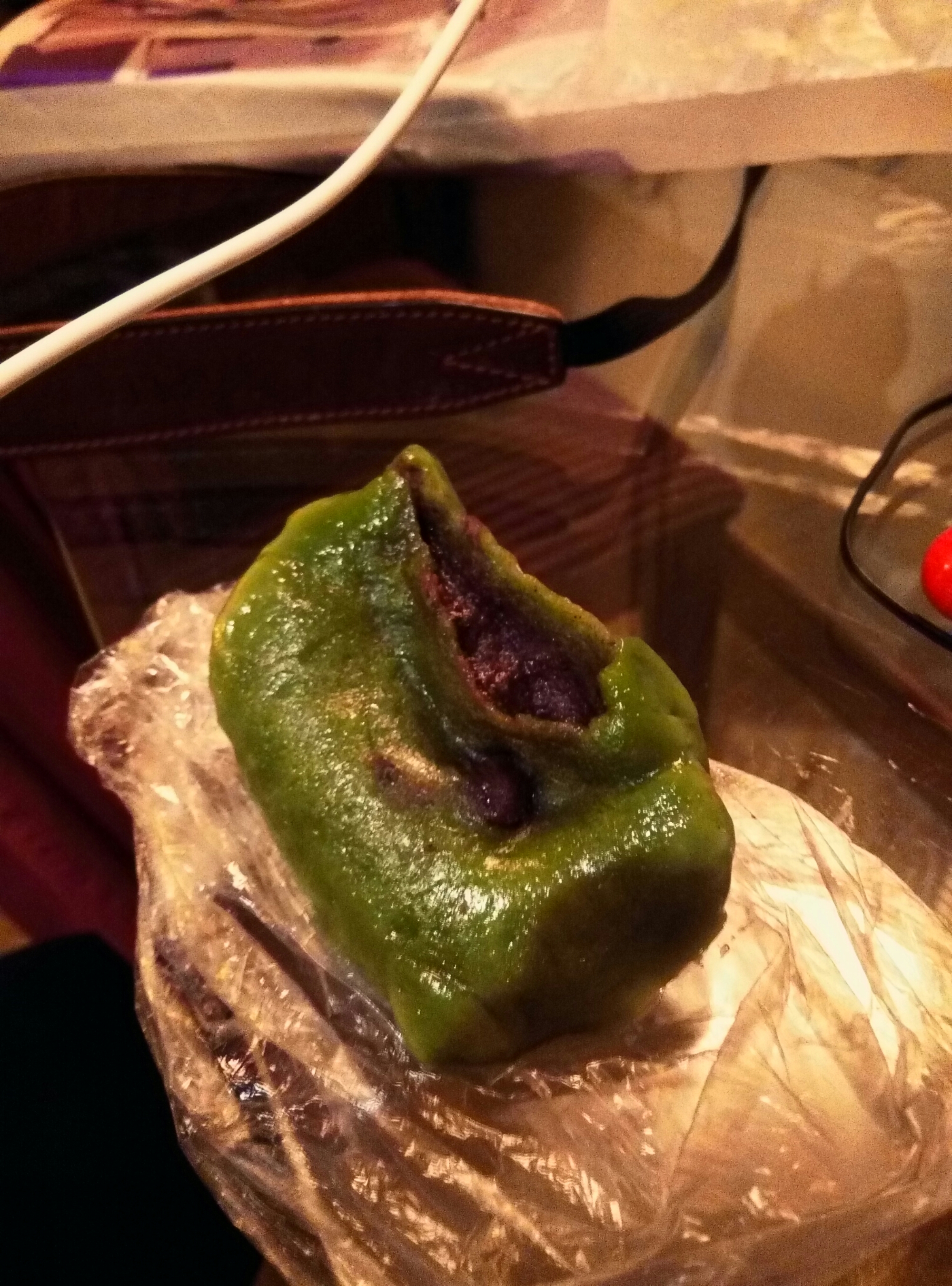
Eating in Shanghai this morningsng for the tomb sweeping festival (sort of like our Memorial Day.) They were serving Sweet Green Dumplings  (青团 qīngtuán) filled with red bean paste. Only served once a year!

image

History of Our World: The Chinese Origins and Foundations Myth

31 Mar

Beyond Yonder HillsUnlike with Korea, China’s origin stories are primarily Creation Myths (which tell of the origin of the world), rather than simply Foundation Myths (which more specifically relate the origin of a people, nation, or culture).   Still, pinning down one final Chinese myth about the origin of the world is an impossible task for even the best student of history. There are simply far too many varieties available, gathered from thousands of diverse cultural backgrounds and centuries upon centuries of oral story-tellers offering their own unique twists and versions. Nonetheless, there are certain elements that carry through as shared themes in the different tales.

DSC08726

Mythology in China is rather special given the conflicting philosophies that pull and tug the stories in multiple directions. What many fail to recognize about the country is that it has at least 6 major religions/philosophical authorities working against one another. The first is the traditional animism or the belief that the earth or nature is alive and has a spiritual essence flowing throughout. Adherents believe that the plants, animals, and earth itself are alive and conscious. It is actually from this belief that most of the traditional origin myths come, since that is the oldest religion or philosophy. Following closely on its heels though is Taoism or Daoism, a religion based upon one of the oldest Chinese classics and book of divination called the I Ching. You will see some elements of Taoism within the origin myths as given because of its age and influence. Still, this religion found itself sharply in conflict with the Confucian and Buddhist philosophers on many occasions. Oddly enough, Buddhism in China seems to mix elements of both Taoism and Confucianism although if frequently fought with them too. But it still offers its own unique twist to myth and legends. Then you have the ancestral worship affecting things. And of course the more recent impact of Christianity, Islam, and Atheism moving in.

The problem with the Chinese myths is the whole Taoism, Buddhism, Ancestral Worship, Animism, and Confucian elements. Sometimes they agree on mythology and come together. Other times they disagreed and re-wrote the old stories with their own variations. It just gets a little confusing. Luckily, the different origin myths were usually old enough that they came out of the Taoist-Animist mix and have many similarities that bring them together into 3 interesting tales. In fact, many seek to combine the three stories into one that flows together.

Variation #1 ~ The One Becomes Two

Some Chinese mythology begins with the theory that the world was initially a giant ball of chaos, all swirling together. The chaos was made out of “Qi,” a sort of gas or ‘energy,’ which-at the moment of the world’s beginning- suddenly split into two different elements. Some Chinese writers argue that this was an almost magical moment, with no sign of a creator. Others propose that it was triggered by a supernatural figure, and still others seem to suggest that the chaos was actually gods in conflict with one another themselves.

Regardless, the two elements that resulted were contrasts in masculinity and femininity, passion and passivity, hard and soft, dark and light, hot and cold. In western variations, we label them Yin and Yang. However, please bear in mind though that our “western adaptations of Yin and Yang” are often not actually primary in the belief systems of the majority of the Chinese. Not all of them were Taoist, as noted above. So while the Chinese myths may mostly agree that the original universal elements were dual in nature, they don’t necessarily all agree with the significance or religious aspect the Taoists have given to those features.

Variation #2: Pangu and the Hundun

The Pangu myth is one of those situations where the newer religions (in this case Taoism) added some stuff to the initial story so that it fit their point of view. Although it fits into the middle if you read the three versions as one story, it was actually the last one to appear in written mythology.

Once again,  the world begins with chaos and utter disorder, but this time the chaos was confined inside the Hundun. The Hundun was shaped like a giant egg, and inside Yin and Yang, male and female, good and evil, light and dark all writhed around in a complete mess.

Inside the the chaos, there slowly grew a giant dragon named Pangu. For centuries he lived and grew, lived and grew. Finally he became so large that he was able to shatter the Hundun egg into two. All the chaos inside spilled out, with the yin elements moving upward where they would become the heavens and the yang elements falling downward where it would become the earth. To keep the two from mixing again, Pangu resolved to stand in between them, holding them apart. Every day, Pangu grew ten feet taller, the earth ten feet bigger, and the heavens ten feet higher. Finally, after 18,000 years everything was as big as it was going to get. Pangu even added some creativity of his own by stomping on the earth to create the flat lands and using his hands to form some of the rivers.

Tragically, Pangu eventually reached the end of his life. As he did so, his body began to disintegrate over top of the earth. Breathing out his last, his breath transformed into the wind and clouds in the sky. His final words the thunder echoing over the land. The sweat and “bodily fluids” became rain. His eyes split into two-the left becoming the sun and the right becoming the moon.His skin became the earth and ground; His veins and muscles hold the earth together.  His arms, legs, and “extremities” were changed into the four compass points and five great mountain peaks (some later consider these to be part of the pillars Nuwa would later repair-see below). The blood and semen (yuck!) changed into water in the rivers and oceans. His hair became trees, plants, and stars. His teeth and bones the metal and rock. His marrows and insides the precious jewels like pearls and jade. 

According to this version, humans actually came from the less than pleasant origin of “bugs” or “fleas” that had lived upon his body. Caught by his breath on the wind as they fell to earth, they became alive and were the original humans. To be honest, some people believe that rather than these being the origins of modern humans, the people created here were more like the dwarves, fairies, and other more supernatural figures. For example, this legend would have you believe that Nuwa and Fuxi were created from him in a similar fashion.

Variation #3: Nüwa and Fuxi

The story of Nüwa and earth’s creation come mainly from  ancient texts such as the Huainanzi, Chu Ci, and Shan Hai JingThis story has several variations, but they tell a pretty consistent story over all. If you watched the recent Chinese 2015 film “The Monkey King” (excellent watch for students of Chinese mythology), you saw one version of Nüwa’s story. 

Some myths suggest Nüwa and Fuxi were simply gods living upon the earth after its creation. Others claim that they were actually the children (grandchildren?) of Pangu himself. However, in literature, Nüwa’s story came 6 centuries before that of Pangu. Nonetheless, Nüwa and Fuxi are depicted in ancient Chinese art as figures with the body of a snake and the top of a human. You can see an ancient depiction of the two on the right. Theirs was a love story, and one that is significant to the origin myth. Actually Nüwa’s story comes in two parts – the creation of humanity and the salvation of the world. 

1) The Creation of Humanity

When the earth and heaven were first divided, two supernatural figures lived on the earth. The first was Nüwa and the second her brother Fuxi. Although they were related, they fell in love with one another and wished desperately for the chance to marry. However, they knew that this was unnatural and were unsure about whether it was appropriate. So Fuxi climbed one of the great mountains with Nüwa and they prayed. One story says they asked that if the heavens approved of their love, then a great mist or fog would gather. If the heavens disapproved, the fog would disappear. To their great joy, the mists of fogs grew very large and permission for their marriage was granted. Another story (the Shan Hai Jing) says that they got permission after they built two separate fires that morphed into one.

Some myths suggest that Nüwa created humanity with the help of her husband, but others suggest she worked alone. Either way, Nüwa got creative and began fashioning human figures out of a mixture of yellow earth, then  after she became tired, she began using mud instead. To help hold everything together she added some ropes or cording to make them stand up. She also gave them legs instead of her own tail and created men and women so they would recreate on their own. Finally, when her work was completed, she breathed life into the figures and created humans. Unfortunately, those made out of yellow earth were of higher quality and were thought to be the forefathers of the aristocracy. The peeople made out of mud were more common and became the ancestors of the poor, working folk.

Nüwa was delighted with her creation and loved them very much, seeing them as her children and treasures on the earth. So when they were in danger, she was willing to do anything to protect them.

2) The Salvation of the World

According to the most ancient of Chinese myth, the earth originally had four separate corners, each of which held 1 or 2 pillars holding up the heavens. These pillars were the only point at which the heavens and earth were connected and had to be closely protected to keep the two from crashing into one another. There was also a concern of the more evil creatures using the pillars as a chance to move up or down between the heavens and the earth. It was during the peaceful time when the pillars were working that Nüwa and Fuxi created humans. But tragedy struck.

Gònggōng or Kanghui, one of the sea gods or sea serpents, unfortunately had the dubious notoriety of having gotten into various fights with the “good deities.” After losing one of the battles, he grew angered (or embarrassed–the myths aren’t quite sure) and broke one of the pillars (named Buzhou Mountain) in a fit of temper. As a result, the whole sky began falling in the northwest as the earth rose in the southeast. This caused the entire axis of the earth to shift and resulted in complete and utter chaos. Fires, Floods, Animals going Wild and eating people-everything went haywire and Nüwa realized something had to happen if the world was to survive.

nuwa

The stories differ on what precisely Nüwa did to save the world, but most go with the Huainanzi’s version. Therein, Nüwa went and found five blue stones, which she used to repair the broken sky (giving it the blue color). Then she  cut of the four legs of the mythological turtle Ao and put them up as pillars to re-set the sky and earth in their places. She also killed off a black dragon who was helping to cause some of the chaos. It is unclear whether she survived her work- some myths have her dying as part of the final solution and sacrificing her body to reform the world. Others say that she lived in peace with Fuxi and helped establish the first Chinese government.

The Combination

Naturally, some chose to accept the stories as independent of one another- particularly since the addition of Pangu came so much later. The minorities are more inclined to accept the Pangu myth, while the larger groups tend to pick up the Nüwa version.  Nonetheless, others choose to produce some combination of the the three. It is fairly simple to see how this would play own.

As Version 1 states, the world originally lay in utter chaos with all the different contrasting elements mixed together. Then Version 2 picks up by stating the chaos however was confined in the Hundun egg, where Pangu grew until he split the egg apart. He is the father of the world, creating earth and the heavens from his body and efforts. When he died, his body mixed with the supernatural elements still in the air to form Nüwa and her brother Fuxi. Together, the two of them created humans and rejoiced. However, all of Pangu’s hard work was nearly destroyed when the pillars he fashioned from his extremities were broken by Gonggong. To save the world Nüwa threw up the five stones to fix the sky and formed the pillars anew. Thus the earth was created and nearly destroyed, while humans managed to survive it all to become the illustrious Chinese we know today.

The varying religions like Buddhism, Animism, Taoism, and Ancestral Worship have picked apart and pieced together these three myths to suit their own story-lines. Thus, we have multiple versions of the Chinese origin myth existing today. 

Whatever the version, the modern eye can clearly see the intricacy and beauty of Chinese mythology in all its forms and fashions. The details, the imagery, the themes and plots spread throughout. The Chinese legends are beautiful and full of magic, ingenuity, passion, and wisdom. The best part is that it is still preserved in the art and style of classic Chinese artistry still preserved today. Take a trip to Beijing and see the paintings on the ancient palace pillars.  Look at the writings and painted visions lining the museum walls. Chinese mythology is a truly unique and stunning creation!


Life in China ~ Flying English Club

28 Mar

DSC_0876

During my stint as a teacher here in China, I’ve had the opportunity to participate in several different campus activities with the students. One of the clubs I have worked with a lot is called the “Flying English Club.” Filled with a mixture of Freshmen, Sophomores, and Juniors, the club has a great collection of students from all around. Even some of the international students join in as a chance to meet Chinese students! 

mmexport1458433463316

Last night, they invited me to a BBQ at one of their teacher’s buildings, so I went out for a night of fun and food. We had such a wonderful time! The students cooked delicious food including sweet potatoes, grilled meat (pork, beef, squid, chicken, mutton), broccoli, mushrooms, green beans, lettuce / grilled greens, tofu, and more. They had also prepared some delicious fruit trays with apples, pineapple, dragon fruit, banana, oranges, tomatoes, and other yummy snacks. So good!  

If you have the chance to go out with your students and play, you should take it! It’s not every day that people can have so much fun 🙂

DSC_0877

Image

Heaven, I’m in Heaven

24 Mar

DSC01551.JPG

Life in China ~ Blossoms of Spring

21 Mar

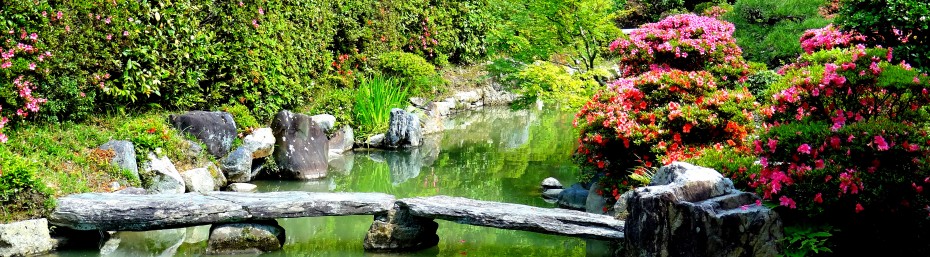
Gave some exams near the Campus Library  and got this treat 🙂 Green and Pink, my favorite colors! I just love the beauty of the flowering season. And here in China, it’ll last until well into the fall!