
Archive | Life RSS feed for this section



Economics ~ Introduction to Managerial Economics
24 MarHello-our internet sucks, so I’m posting this for some of my students 🙂 You’re welcome to enjoy it too!
What is Managerial Economics?
- Economics (经济学)= The study of how resources (资源) are created (创造), gathered (搜集,聚集), traded (营业), and divided (分离,划分).
- Resources = Anything you use to help the company work. Examples: time, money, land, tools, labor, raw materials.
- Natural Resources (自然资源) = Resources created by nature. Examples: wood, water, air, rocks/stones, flowers, natural chemicals
- Man-Made Resources (人造资源) = Resources created by humans by either combining (mixing together) or changing natural resources into something new. Examples: jewelry, paint, fabric, steel, hammers.
- Limited Resources (限制性资源) = Resources either no longer being created or only created in small amounts. Meaning the supply is not enough.Examples: Gold, Diamonds, Water in a desert.
- Unlimited Resources (无限制性资源) = Where there is a large amount of the resource or it is created fast enough to replace any that is lost. Supply is enough.Examples: Water, Air.
- Raw Materials (原材料) = The resources that are put into the product. Example: If we make a computer, raw materials would include wires, plastic, metal, paint, springs, etc.
- Market-Supplied Resources (市场提供的资源) = Resources owned by someone outside of the company. Examples = Taxes, Utilities, Rent, Raw Materials, Wages
- Owner-Supplied Resources (业主提供的资源) = Resources owned by the company’s owners.
- Resources = Anything you use to help the company work. Examples: time, money, land, tools, labor, raw materials.
- Manager (经纪, 经理) = A person who is obligated to ensure the company (or department) is effectively organized and controlled.
- Managerial Economics (管理经济学) = The study of the best method for managers to create, gather, trade, and divide the company’s resources.
Goal of Effective Managers
- Wealth or Profit (收益) Maximization Rule = #1 Goal of Effective Managers is to make the owner’s the most profit (as long as they do so ethically and legally)
How to Maximize Profits (收益)?
- Profit = Revenue – Cost
- Two ways to Maximize Profit:
- Make the Highest Revenue
- Pay the Lowest Costs
What are Revenue, Cost, and Profits?
- Revenue (收入) = Total Income or Money the Company makes from its work.
- Cost (成本) = The losses or sacrifices the company makes in exchange for getting and using resources in its work.
- Opportunity Costs (机会成本) = The company’s costs created because it lost some opportunity.
- Opportunity Cost of using Market-Supplied Resources = $$ Spent paying for those resources (you lose the opportunity to spend the money on something else)
- Opportunity Cost of using Owner-Supplied Resources = $$, time, effort lost that the owner would have had if they spent their resources on something else.
- 2 Types of Opportunity Costs
- Explicit Costs (明确的成本) = Any money the company pays owners of Market-Supplied Resources
- Implicit Costs (隐性成本) = Anything the Owner loses by giving the company Owner-Supplied Resources
- Total Economic Cost = Explicit Costs + Implicit Costs
- Opportunity Costs (机会成本) = The company’s costs created because it lost some opportunity.
- Profit (收益) = Everything the company gets to keep from the Revenue after it pays its costs!
- Present Profit v. Future Profit
- Present Profit = What we are keeping right now. (Most Important)
- Expected Future Profit = What we think we’ll get in the future (Companies with higher expected future profits have more value. While companies with a possibility of low future profits will have a lower value)
- Profit is Counted in Two Ways
- Example: Joshua has a company (Company A) that just made $150,000 in Revenue. The company spends $9,000 on Taxes and Utilities, $3,000 on Wages, and $5,000 on Raw Materials. Joshua gave the company the building but would have made $2,000 if he used it as a school instead. He also lost $5,000 on his original investment.
- Economic Profit (经济利润) = Revenue – Total Economic Cost
- What is Company A’s Economic Profit?
- Accounting Profit (会计利润) = Revenue – Explicit Costs.
- What is Company A’s Accounting Profit?
- In Managerial Economics, we usually mean Accounting Profit when we say “Profit”
- Present Profit v. Future Profit
More to come later 🙂
Sample Corporate Balance Sheet
24 Mar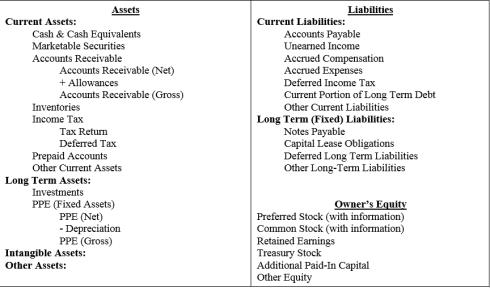
If you are looking for a Sample Balance Sheet, here is one I created for my Corporate Finance students. It’s not perfect of course, and you can always add or subtract things. Just download it as a Word Doc (or if that is not available, copy and paste to a word doc) and modify to suit your needs!
SAMPLE BALANCE SHEET
Here are some real-world examples you can use to compare:
An EXCEL ready-made template is available as well here: “Corporate Balance Sheet & Income Statement (Automatically Formulated Worksheet with Metrics”
Not Good
23 MarMine is Iassannn (a little consonant heavy 😛 )–I sound like a sleezy dragon, hissing and dragging out my letters.

Life in China ~ Bring It (Managerial Econ Style)
22 Mar😛 I am teaching a class of students whose English is particularly bad, but I had them last semester too and we have been moving along. It takes translating every couple of words (money, war, economy, market, cash, coin, card) to communicate, but we were happy with our steady if slow pace 🙂
Then Today, I had two new students join the class from Int’l Trade 1 (the best students, include one who has excellent English). At the beginning, I asked the students to translate one of the words as usual. Normally it takes us a bit to look it up and figure out a Chinglish version. Now, immediately the new boy spits out verbatim the precise 3 sentence long definition from the textbook by memory. 0_0 It was the funniest thing. The entire class stopped, turned and stared at him. One girl threw up her hands, another started groaning. The entire group almost in unison went “ooooohhhhhh” and one actually WHIMPERED. LOL. He jerked back and looked around. After that he figured out pretty quick the others weren’t at that level. 🙂 Seriously, we’re working at “this is called demand” level and he’s off on QD = a + bP + cT + . . . . level. Boom. . . mic dropped, bar raised.
Life in China ~ Blossoms of Spring
21 MarGave some exams near the Campus Library and got this treat 🙂 Green and Pink, my favorite colors! I just love the beauty of the flowering season. And here in China, it’ll last until well into the fall!


Life in China~ Simple Chinese (Meats)
18 MarLife in China is so much simpler with a few Chinese “food” words under your belt. To be honest, I prefer the places where I can point and buy. But even then, you often want to verify the type of meat because pictures are hard to discern or you may not want to eat certain meats. For example, I have many Muslim students from Indonesia or Malaysia who want to avoid Pork. I personally don’t do fish or seafood due to allergies. To help, here is a list of common meats in simple Chinese!
- Meat = 肉 = Ròu = Roh
- Chicken = 鸡肉 = Jīròu = gee roh
- Jī being chicken. So if you want a specific part of the chicken add Chicken (Jī) then the part (i.e. Chicken Wings = jī chì).
- Pork =猪肉 = Zhūròu = Joo roh
- Beef = 牛肉 = Niúròu = New roh
- Fish = 鱼 = Yú = Yoo
- Shrimp = 虾 = Xiā = Tseeah (fast)
- Mutton = 羊肉 = Yángròu = Yahng roh
- No ________ = 不 + Meat= Bù + Meat
The most common varieties are chicken, pork, beef, and mutton. They are used almost interchangeably in rice dishes, baozi (dumplings), noodles, etc. Plus, there is often a “red bean” or “vegetable” option containing no meat. So if you want meat in your dish, use one of these words to A. make sure meat is included and B. that it’s the meat you want 🙂

“She was free in her wildness. She was a wanderess, a drop of free water. She belonged to no man and to no city” ~ Roman Payne
Social Media


My Websites

Traveler’s Loadstone

Language Translation






 Deceptively Blonde