Archive | Teaching RSS feed for this section

Cultural Immersion through Names

29 Aug

Hello!

Are you off on your study abroad trip already? Or planning one for the near future? Good luck! I hope you all have a wonderful time 🙂

Quick Question – What’s your name?

No, I’m not trying to start a bank account with your info. “What’s Your Name” is probably the #1 most asked question of student’s abroad. And seriously, it seems like it’d be the easiest one to answer. BUT THAT’S A LIE!  Names are sometimes the worst thing to try to communicate in foreign languages.  

For me, the answer is “wo jiao Olivia.” At one point it was “Ji ireum eun Olivia imnida” or “Watashi no namae wa Olivia desu” or “Me Llamo Olivia.”  Of course, all of those are potentially wrong or pronounced wrong so I greatly prefer the simple “Olivia.” 

Unfortunately, even when I just say my name by itself, I still ran into a lot of trouble. Why?  Because my name is not pronounceable in some languages! Sure, it come’s out normally in the US. But in Spanish, it sounds like “Oleebeea.”  Korean ~ “Oh Ri bee ah”. Japanese ~ “Ah ree bee ah.” Chinese ~ “O” and they stop.  None of them want to say the “v” and “l” and some even don’t like the “O”!

And I’m not the only person who has this trouble. Peter (“Beetle”), Kristin (Kreeseen), Martha (“Marta”), Elizabeth (“Ah lee sa bet”), Phoebe (“Pho buh” or “Phee buh”), Jack (“Check”), Jared (“Chard”).  Usually when we communicate with people in our new countries, we’re at least trying to speak in their tongue. But with our names, we keep wanting to preserve the original word and it just doesn’t work.  Lots of names do not really communicate in foreign languages or end up butchered. 

So instead you get used to spending 5-10 minutes with every person you meet slowly enunciating the syllables and repeating it over again. It makes you frustrated and them embarrassed.  So PICK A NAME THEY CAN EASILY SAY.

There are many ways you can approach finding a name in the foreign language:

  • Try just translating your own name.
  • Try picking one of their names that has the same meaning as your own.
  • Try picking a name that has the same sound as yours, but maybe a different meaning.
  • Try just picking a brand new name in their language that you really like.

For example, when I first moved to China a lot of people had problems with my name. Like I said above, they got the “O” but that was about it. In fact, with little kids I just became “Teacher O” and my college students preferred “sis” or “laoshi” (teacher).  My name simply didn’t work. 

Finally, I gave up and took a poll. I asked my students to help me come up with a name that worked.  After some research into my name and the meaning of my name (which is important to the Chinese), we agreed that there wasn’t a precise translation in Chinese itself.  Combined with my middle and last names, my full name means “The Gods Bring Blessings of Peace and Wisdom from Heaven.”  The students didn’t like the names that had the same meaning (they felt it lost the beauty of the original sound). And they couldn’t quite get the original sound with the same meaning. So we finally came up with 奥丽维娅 (ào lí wéi yà).

  • ào means “Mysterious or Profound.” 
  • lí is “Beautiful”
  • wéi is “Safeguard or Guardian”
  • yà is sort of like “Pretty Girl.”  

The students informed me that it was important in Chinese to not only have the correct sound, but also the correct characters since sometimes many characters make the same sound. They helped me go through and pick out characters that made the sound and meaning as close to “Olivia” as we could get. 

And it helps so much!  I practiced saying it for a while, and now everyone immediately knows what I’m saying when I introduce myself. They are always impressed that I took the time to come up with a name for them, it shows that I want to communicate with them and build relationships.  I’m meeting them half-way and they will frequently be more patient with helping me figure out their names in exchange.  I’ve added it to my LinkedIn and Resume and it makes them feel more confident introducing themselves.  The people who added me after the Chinese name was added more than doubled than those who added me before.  

Not only that, but I got a history lesson behind Chinese names, a name I treasure because it was made with love by them, and a name that they felt showed my nature. So I have two precious names in my heart – English and Chinese.

Think about it from your perspective. Say you are in America and a student comes up to you with the name “ào lí wéi yà.”  Now, maybe in their language (like Chinese), you have to not only worry about the syllables sound, you also have to know the proper tone. Say it in the wrong tone and the whole name is wrong. For example, “Ma” could be mom or horse depending on how you say it. 0_0  

So you could either try to introduce yourself to Olivia (which you are confident saying) or “ào lí wéi yà” which you frequently butcher and feel like an idiot even attempting.  Odds are, you’re going to go with “Olivia.”

The same is true for all the other people in the world. If you came to China, they would feel much more comfortable if you gave them a name they can actually pronounce easily and correctly. They’ll remember your name better too!  For my students, it’s always easier to remember those who gave me English names than the ones who stick to their original names. This is one of the reasons why Oral English teachers almost always start by having kids pick an English name.  

It’s only fair that we do the same favor for people when we go to their countries. Pick a Chinese name. A French name. A Kenyan name.  Get into their culture and into their language easier by creating a whole new, language-appropriate, name for yourself. It makes conversation and relationships easier for them to attempt and will help you make a more lasting impression.  

Finally, it gives you the chance to re-invent yourself a bit too.  Maybe “Olivia” is shy, quiet, not very adventurous, and not great at friends. But ào lí wéi yà is outgoing, brave, and ready to meet new people!  Sure, it isn’t the same as an official name change / re-invention, but it really does give you a chance to feel like a new person. And since Studying Abroad will definitely change your character and personality – maybe having a new name to go with it is a good thing.  

~ Love you guys! Let me know how your trip abroad goes!  Tell me if I can help with any questions!❤

Life in China ~ Chinglish Travel

5 Aug

Airport = Airplane Station

(Comes from the fact that we have Subway Stations and Train Stations, so naturally it is a Airplane Station 😛 )

Understanding Compound Interest

14 Jun

As always, this lesson is not intended to be professional advice. This is simply lesson material for ESL students in a Managerial Economics and Corporate Finance class. Posted here for their use or for helping other students.

Corporate Value (值)

Financial officers and Managers are extremely responsible for the monetary (货币) goings-on in their companies. As we said before, the Wealth Maximization Rule means that Financial and Corporate Managers are required to maximize (最大化) the profits (收益) for their investors (投资者). 

However, maximizing profits requires in-depth (深入)planning and micro-managing (微观) your funds today while considering (考虑) future profits as well.

There are two types of Value (值) that you should be aware of in Finance and Economics.

The first is called Present Value (现值) and is the value today of something that will increase in value in the future. ExampleWhen we loan someone $1,000 at 10% interest, we know that our $1,000 loan will increase in value in the future. Present Value = PV.

The second is called Future Value (未来价值) and is the value that the item will have in the future. Future Value = FV.

Interest (利)

I’ll make another post later discussing the many ways to use Present and Future value in your company, but today I just wanted to talk about using them to calculate (计算) “Compound Interest” (复利).  

Usually, when we loan money to someone or invest (投资) our money in something, we do so on the condition that we receive back more money than we put in.  Our corporation is not a charity (慈善机构), we don’t loan you things for free!  The original money we invest is called the Principal (本息).  The extra money we get on top is called the Interest (利).  

Example ~ Company A (a large global corporation) invests $100,000 in a small new business called Company B.  Company B has 10 years to pay it back. But Company A doesn’t do this for free ~ they want to maximize their profits too. That means they have to make some money on this contract (合同).  So they ask Company B to pay an additional 7% per year.   

$100,000 = Principal
7% = Interest

COMPOUND INTEREST (复利)

Problem! ~ 7% of what?  
Answer! ~ It depends:)   It depends on how Company A decides to count it.


There are two separate mathematical formulas (数学公式) you can use to figure out the Interest.  

The first one is called Simple Interest (单利) and I’ve already looked at it before.

The second method is called Compound Interest (复利). Compound Interest says that each payment period, Company B is going to pay an additional 7% of the currently owed principal! Lenders and Investors really like compound interest a lot better than simple interest.  

For example: I borrow $1000 due in two years.  My interest rate is 10%.  

If I use Simple Interest:  Year 1, I owe $1000 + 10% interest = $1100.  Year 2, I owe $1100 + (10% of $1000) = $1200. 🙂 

If I use Compound Interest: Year 1, I owe $1000 + 10% interest = $1100.  Year 2, I owe $1100 + (10% of $1100) = $1210

The formula for Compound Interest is:

I = Interest
P = Present Value
R = Interest Rate
T = Number of Years Involved
N = Number of Times a Year

Example 

Company A (a large global corporation) invests $100,000 in a small new business called Company B.  Company B has 10 years to pay it back. The interest rate is 7% compounded  bi-annually.   What is the Total Interest (利) you will pay over 10 Years?

Calculating FUTURE VALUE and PRESENT VALUE using COMPOUND INTEREST

The total interest is of course important to both Company A and Company B, there are two other important numbers that the financial managers of Company A want to know–the Present Value of their money and the Future Value of their money.  

Future Value

FV = Future Value (how much money you will make in total)
PV = Present Value

R = Interest Rate
T = Number of years involved
N = Times per Year

Using our example above with Company A & B, the Future Value is calculated like this:

That means Company A will make a total of $286,968.46 if they invest their $100,000 in Company B now. Over 10 years, their $100,000 will change into $386,968.46.:) We like this plan!

Present Value

Sometimes, for example with bonds (债券), we know the Future Value (how much money will be paid to us in the end). But we don’t know how much money has to be invested (Present Value) to get that future result.  So Present Value is calculated by the formula: 

PV = Present Value 
FV = Future Value

R = Interest Rate
T = Number of years involved
N = Number of Times per Year

Example: Mary Jane knows that in 4 years, she needs to have a total of $150,000 to pay her college tuition. She has an interest-generating account that gives her a 4% compound interest rate bi-annually on everything she puts in. How much money should she invest today (Present Value) in order to have $150,000 in 4 years?

That means that Mary Jane needs to put $101,336.67 in her bank account now in order to get $150,000 in the future. 

JPEG

KEY TERMS TO REMEMBER

  1. Value (值)
  2. Present Value (现值)
  3. Future Value (未来价值)
  4. Interest (利)
  5. Simple Interest (单利)
  6. Compound Interest (复利)
  7. Principal (本息)
  8. Monthly (每月一次)
  9. Weekly (每周)
  10. Annually (每年)
  11. Bi-Annually (一年两次)
  12. Quarterly (季刊)

FORMULAS TO REMEMBER

Compound Interest

Future Value

Present Value

Smart Elephant

14 Jun

image

😁 My student kept mixing up element and elephant today. “The first elephant says you must obey universal laws . . . ” “The second elephant means do not take advantage .. . ” Sounded like one of those “what does my dream mean” conversations :p

Understanding Simple Interest

6 Jun

As always, this lesson is not intended to be professional advice. This is simply lesson material for ESL students in a Managerial Economics and Corporate Finance class. Posted here for their use or for helping other students.

Corporate Value (值)

Financial officers and Managers are extremely responsible for the monetary (货币) goings-on in their companies. As we said before, the Wealth Maximization Rule means that Financial and Corporate Managers are required to maximize (最大化) the profits (收益) for their investors (投资者). 

However, maximizing profits requires in-depth (深入)planning and micro-managing (微观) your funds today while considering (考虑) future profits as well.

There are two types of Value (值) that you should be aware of in Finance and Economics.

The first is called Present Value (现值) and is the value today of something that will increase in value in the future. ExampleWhen we loan someone $1,000 at 10% interest, we know that our $1,000 loan will increase in value in the future.  Present Value = PV.

The second is called Future Value (未来价值) and is the value that the item will have in the future. Future Value = FV.

Interest (利)

I’ll make another post later discussing the many ways to use Present and Future value in your company, but today I just wanted to talk about using them to calculate (计算) “Simple Interest” (单利).  

Usually, when we loan money to someone or invest (投资) our money in something, we do so on the condition that we receive back more money than we put in.  Our corporation is not a charity (慈善机构), we don’t loan you things for free!  The original money we invest is called the Principal (本息).  The extra money we get on top is called the Interest (利).  

Example ~ Company A (a large global corporation) invests $100,000 in a small new business called Company B.  Company B has 10 years to pay it back. But Company A doesn’t do this for free ~ they want to maximize their profits too. That means they have to make some money on this contract (合同).  So they ask Company B to pay an additional 7% per year.   

$100,000 = Principal
7% = Interest

SIMPLE INTEREST (单利)

Problem! ~ 7% of what?  
Answer! ~ It depends 🙂   It depends on how Company A decides to count it.

There are two separate mathematical formulas (数学公式) you can use to figure out the Interest.  The first one is called Simple Interest (单利). Simple Interest says that each payment period Company B is going to pay an additional 7% of the original principal ($100,000).  The formula for Simple Interest is:

I = Interest
P = Present Value
R = Interest Rate
T = Number of Years Involved

Example

Company A (a large global corporation) invests $100,000 in a small new business called Company B.  Company B has 10 years to pay it back. The interest rate is 7% per year.   What is the Total Interest (利) you will pay over 10 Years?

Calculating FUTURE VALUE and PRESENT VALUE using SIMPLE INTEREST

The total interest is of course important to both Company A and Company B, there are two other important numbers that the financial managers of Company A want to know–the Present Value of their money and the Future Value of their money.  

Future Value

FV = Future Value (how much money you will make in total)
PV = Present Value

R = Interest Rate
T = Number of years involved

Using our example above with Company A & B, the Future Value is calculated like this:

That means Company A will make a total of $70,000 if they invest their $100,000 in Company B now. Over 10 years, their $100,000 will change into $170,000. 🙂 We like this plan!

Present Value

Sometimes, for example with bonds (债券), we know the Future Value (how much money will be paid to us in the end). But we don’t know how much money has to be invested (Present Value) to get that future result.  So Present Value is calculated by the formula: 

PV = Present Value 
PV = Future Value

R = Interest Rate
T = Number of years involved

Example: Mary Jane knows that in 4 years, she needs to have a total of $150,000 to pay her college tuition. She has an interest-generating account that gives her a 4% interest rate on everything she puts in. How much money should she invest today (Present Value) in order to have $150,000 in 4 years?

That means that Mary Jane needs to put $129,310.35 in her bank account now in order to get $150,000 in the future. 

JPEG

KEY TERMS TO REMEMBER

  1. Value (值)
  2. Present Value (现值)
  3. Future Value (未来价值)
  4. Interest (利)
  5. Simple Interest (单利)
  6. Principal (本息)

FORMULAS TO REMEMBER

Simple Interest

Future Value

Present Value

Graduation Approaches!

8 May

My beloved students are abandoning me! Going off to newer and bettter things. Wishing them all the luck and love in the future!

image

image

image

Corporate Finance – What is the Balance Sheet?

27 Apr

**As always, my work is designed with Chinese ESL student in mind. Please consider this when reading.

Corporate Finance has 3 main types of Financial Documents:

  • Balance Sheet ~ Value of the Company (How it is divided between Debt and Equity)
  • Income Statement ~ Specific Use of Assets and Liabilities
  • Cash Flow Statement ~ How Cash is Handled from the moment it enters the company until it leaves.

Balance Sheet

We all know that Revenue has to be bigger than Costs/Expenses if the company is going to be successful (Revenue – Cost = Profit). And if you are a financial manager, your legal responsibility is to increase profits for the Shareholders (earn a profit). 

However, for years all that companies worked with were Income Statements. Unfortunately many of them quickly realized they could hide money away in methods not put on the Income Statement. Not only that, but the Income Statement didn’t really outline all of the important factors used in looking at Profit.  So now we have the Balance Sheet -a financial document intended to make everything more honest and clear.

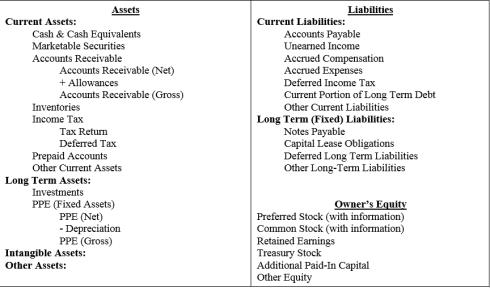
The Balance Sheet summarizes the Assets, Liabilities, and Equity at a certain date.

  •    It is an overall summary of what the company looks like. 
  •   It explains to the Business how well the company is functioning
  •   It explains to Owners how well their Equity is doing
  •   In general, it tells us if the company will be profitable or not.

For example, how much is the company worth July 2016?

General Equation (Assets = Equity – Liabilities)

  • Assets = Everything owned by the company.  Obtained by either creating capital or obtaining debts (borrowing money)
    • Current Assets –Assets that will be turned into cash within 1 Year
    • Long-Term (Fixed) Assets – Assets that will be turned into cash within more than 1 Year
    • Intangible Assets – Assets that you cannot see, but that still exist
  • Liabilities = All the debt the company has to pay
    • Current Liabilities—Debts to be paid this year.
    • Long-Term Liabilities—Debts to be paid in more than 1 year.
  • Equity (Net Worth) = Assets – Liabilities (The Company’s Value for the owners)
    • Owner’s Equity (Owner’s Investment – Owner’s Withdrawals from the Company +/- Net Income/Loss)
    • Retained Earnings
    • Net Profits or Losses


The Balance Sheet will be organized according to the “Liquidity” of the category (meaning how quickly that category of assets, liabilities, or equity can be changed into cash). The farther down the list we go, the less liquid the categories become.

EXAMPLE

Assets

Calculating the Value of a Company

25 Apr

As always, this lesson is not intended to be professional advice. This is simply my lesson material for ESL students in a Managerial Economics class. Posted here for their use or for helping other Economics students.

Finding the Value of the Firm

We measure the success of a financial manager (how well they maximize profits) by finding the overall Value of the Firm (公司的价值).  

Value of the Firm = Value of the Company = Present Value (现值)= How much money ($$/¥/₩) the company would be worth if you tried to sell it today (多少钱该公司将是值得的,如果你想出售它). The Value of the Firm should include

  1. How much money the company is worth today and
  2. Expected profits in the future. 

Mathematical Equation for Calculating the Value of the Firm

  1. Value of the Firm = Current Profit + Expected Future Profit.

Each Year’s Profit is calculated with the following formula:

  • X = Current or Expected Accounting Profit (预期会计利润) = Revenue – Explicit Costs
  • R = Risk-Adjusted Discount Rate (风险调整贴现率) (although we hope we will make the expected accounting profit this year or in future years, there is always the possibility that we will not. No one will pay us the full expected value of the company because of this risk. So to give the buyer some protection, just in case, we remove the Risk-Adjusted Discount Rate from the total.)(我们从方程中删除的金额,因为我们现在可能不会真正使所有预期的利润,我们想要的)
  • T = Number of Years from Today

EXAMPLE

Year 1, Company A makes $180,000. Year 2, Company A makes $150,000. Year 3, Company A makes $100,000. The Risk-Adjusted Discount Rate is 13%. 1年,公司180000美元。2年,公司150000美元。3年,公司100000美元。风险调整贴现率为13%

The Equation for 1 Year is:

The Equation for 3 Years is:

Filling in our known information, the equation for the Value of Our Firm is:

Value of the Firm = $346,069


Exam Day!

19 Apr

Had our first major Mid-Term exam yesterday (your today). Then we took our online computer exams – Three classes of students in 6 hours (+ another 2 hour class I taught). Busy Day!

DSC_0909DSC_0901 DSC_0910

Life in China ~ a Party v. the Party

10 Apr

LMAO!

I was asking my students on our WeChat group (like a Group Chat) if they had class Monday night so we can schedule our exams.

D quickly replied “No, I have a party class.” 0_0

Party class?  Say what!?!  And I wasn’t invited?  How rude!

The group erupted with 63+ Chinese-language messages in a matter of minutes as  the class leader started with “What the HE** is a party class.” Another “ooh, class on how to dance.” “Let’s Party!” “Can I come?” “Do you get to drink?” Lots and lots of laughing pictures and emoticons.

At the same time a whole line of students with”I don’t think the teacher will understand.” “Oh, that’s a bad translation.” “The teacher is going to think you want to go party.” “This is very bad.” “You shouldn’t say that. You cannot trust translation my dear.” “Don’t you know to stop and check every three words?  D replies again–“Oh, no! Now I think the teacher will misunderstand me!” (Horror Face).

At which point, the whole group started posting a series of Chinese phrases that have really bad English translations.  Like “My father-in-law isn’t coming” which translates as “The father-in-law will not be coming to my bed.” It was bad 😛 

My response: “Is that a class party? Party during class? Class about how to party?” This sounds fun and now I’m sad I wasn’t invited to the party lesson! 😦 😦 😦 ”  LOL

Finally, one of them came back with a screen capture of the definition and translation in the Chinese-English dictionary of “Communist Party”–“It’s this one teacher, not a “party class” it’s THE Party class.”  Ah! Makes Much More Sense. . . . And a much better reason for not being able to make the Exam on time! 😛