
Had our first major Mid-Term exam yesterday (your today). Then we took our online computer exams – Three classes of students in 6 hours (+ another 2 hour class I taught). Busy Day!


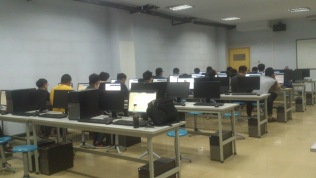
Had our first major Mid-Term exam yesterday (your today). Then we took our online computer exams – Three classes of students in 6 hours (+ another 2 hour class I taught). Busy Day!
Hello!
A new “Life in China” post is here 🙂 . This week, I’m kind of focusing on Money and Banking in China. I wanted to start by looking at Chinese currency or money and what it is worth. 🙂
In China there are three important money terms you should know- Yuan, Jiao, and Renminbi.
 Renminbi (Ruhn meen bee) is the official name of the Chinese currency and is abbreviated on the foreign exchange market as RMB. So if you wanted to exchange money to the US Dollar (USD), you would officially say “I need to exchange RMB to USD.”
The RMB is then broken down into Yuan (yoo ehn), their most basic unity of money which is usually noted with a ¥. Because the Yuan is more commonly discussed, the exchange market will sometimes informally abbreviate the currency as CNY. Do not confuse this with the Japanese Yen ( ¥) which has the same symbol or the Korean Won which sounds remarkably similar (the names of both the Japanese and Korean currencies are actually derived from the word Yuan and thus it can be quite confusing).
Basically, the RMB has its own version of the dollar bill called a Yuan. So if we were talking about the Chinese currency, we would use Renminbi. But if we were asking about specific amounts of money (i.e. how much is that, how much is in your bank, this costs _____), we use Yuan. ¥6 is approximately $1 in foreign exchange (meaning that for every $1 you would get ¥6 or vice versa.
On the streets, Yuan = Mao = Kuai = Kuai Qian. Mao because the bills all have the face of Chairman Mao on them–to be honest this is more common amongst expats than locals 🙂 . Kuai (coo aye) because that is the ancient Chinese word for “piece” when they used pieces of silver. Kuai Qian (coo aya chee ehn) because that is the ancient Chinese phrase for “Pieces of Money.” So just like Americans speak in both “dollars” and “bucks,” the Chinese might at any given moment talk about “Five Yuan,” “Five Kuai” or “Five Kuai Qian.” Listen carefully when they speak–and don’t mix up the Qian (money) for Qi (7) since they sound similar to us!
Yuan come in bills of ¥1, ¥5, ¥10, ¥20, ¥50, and ¥100 respectively. ¥100 is the highest possible bill you can use (which makes for a funny sight for companies since it’s not actually a lot of money – $16 – and most people don’t use cards here. So you are constantly paying in cash, which means that the store always has tons of cash on hand. You’ll see people coming and leaving the bank with hundreds of “¥100” bills in their purses. I have to deposit a whole wad each time my paycheck. Little dangerous, but makes me feel quite rich! 🙂
On the front is Chairman Mao Zedong and the number 1. On the back is the very famous Xi Hu Lake or West Lake in Hangzhou.


There is also a One Yuan Coin:

On the front is Chairman Mao Zedong and the number 5. On the back is Taishan Mountain (泰山) in the Shandong Province.


On the front is Chairman Mao Zedong and the number 10. On the back is the Yangtze River’s Three Gorges (Qutan, Wu, and Xiling).


On the front is Chairman Mao Zedong and the number 20. On the back is the Lijiang River at Guilin


On the front is Chairman Mao Zedong and the number 50. On the back is the Potala Palace in Lhasa, Tibet.


On the front is Chairman Mao Zedong and the number 100. On the back is the Great Hall of the People (close to Tienanmen Square in Beijing) which is where the National Congress is held.


Of course, where America has its dimes, nickels, and quarters, China has its Jiao (fractions of a Yuan). Jiao actually comes in either coins or bills as you can see pictured below. There are 5 Jiao (1/2 of a Yuan in value) and 1 Jiao (1/10 of a Yuan in value). For Americans, it would be similar to having a 50 cent piece and a dime. So we have Cash (Yuan ¥) and Fractions of a Yuan (Jiao) used in the daily, current Chinese Renminbi currency or RMB.


LMAO!
I was asking my students on our WeChat group (like a Group Chat) if they had class Monday night so we can schedule our exams.
D quickly replied “No, I have a party class.” 0_0
Party class? Say what!?! And I wasn’t invited? How rude!

The group erupted with 63+ Chinese-language messages in a matter of minutes as the class leader started with “What the HE** is a party class.” Another “ooh, class on how to dance.” “Let’s Party!” “Can I come?” “Do you get to drink?” Lots and lots of laughing pictures and emoticons.
At the same time a whole line of students with”I don’t think the teacher will understand.” “Oh, that’s a bad translation.” “The teacher is going to think you want to go party.” “This is very bad.” “You shouldn’t say that. You cannot trust translation my dear.” “Don’t you know to stop and check every three words? D replies again–“Oh, no! Now I think the teacher will misunderstand me!” (Horror Face).
At which point, the whole group started posting a series of Chinese phrases that have really bad English translations. Like “My father-in-law isn’t coming” which translates as “The father-in-law will not be coming to my bed.” It was bad 😛
My response: “Is that a class party? Party during class? Class about how to party?” This sounds fun and now I’m sad I wasn’t invited to the party lesson! 😦 😦 😦 ” LOL
Finally, one of them came back with a screen capture of the definition and translation in the Chinese-English dictionary of “Communist Party”–“It’s this one teacher, not a “party class” it’s THE Party class.” Ah! Makes Much More Sense. . . . And a much better reason for not being able to make the Exam on time! 😛

Today, it’s Belgium. Before, it was France.
There also is Brazil, where the Zika virus is rampant. And tomorrow could bring an earthquake, tsunami or hurricane somewhere else.
The drumbeat of terror attacks, health risks and natural disaster crises around the world has directors of growing university study-abroad programs continually monitoring international security updates and advisories. Program heads on Iowa’s campuses were paying attention Tuesday, for example, when news broke of more terror attacks — this time in Brussels.
None of Iowa’s three public universities have students studying abroad in Belgium right now, but Iowa State University — for one — has an exchange program planned there in spring 2017. ISU’s study abroad director, Trevor Nelson, said he doesn’t foresee Tuesday’s attacks derailing that program.
“But we have to monitor the situation and make the best determination about whether you are putting students in harm’s way,” he said. “At this point, I don’t believe we are in a position to put that program on hold.”
Nelson said study abroad programs these days have to be “more diligent in terms of monitoring what is happening in other parts of the world.” But, he said, that’s not necessarily indicative of a more dangerous international study environment.
Rather, he credited it — among other things — to a rise in students taking advantage of the opportunity.
“It’s partly a facet of the number of students who are now studying abroad,” he said. “And they are going to every continent.”
When Nelson started as the ISU study abroad director 25 years ago, about 200 students were involved. In the 2015 budget year, ISU sent 1,633 students oversees through a variety of study programs to every continent including Antarctica.
“And the type of students who are studying abroad has changed as well,” he said. “Twenty-five years ago, those who went on semester long programs tended to be self-starters and more independent and resilient than today.” . . . .
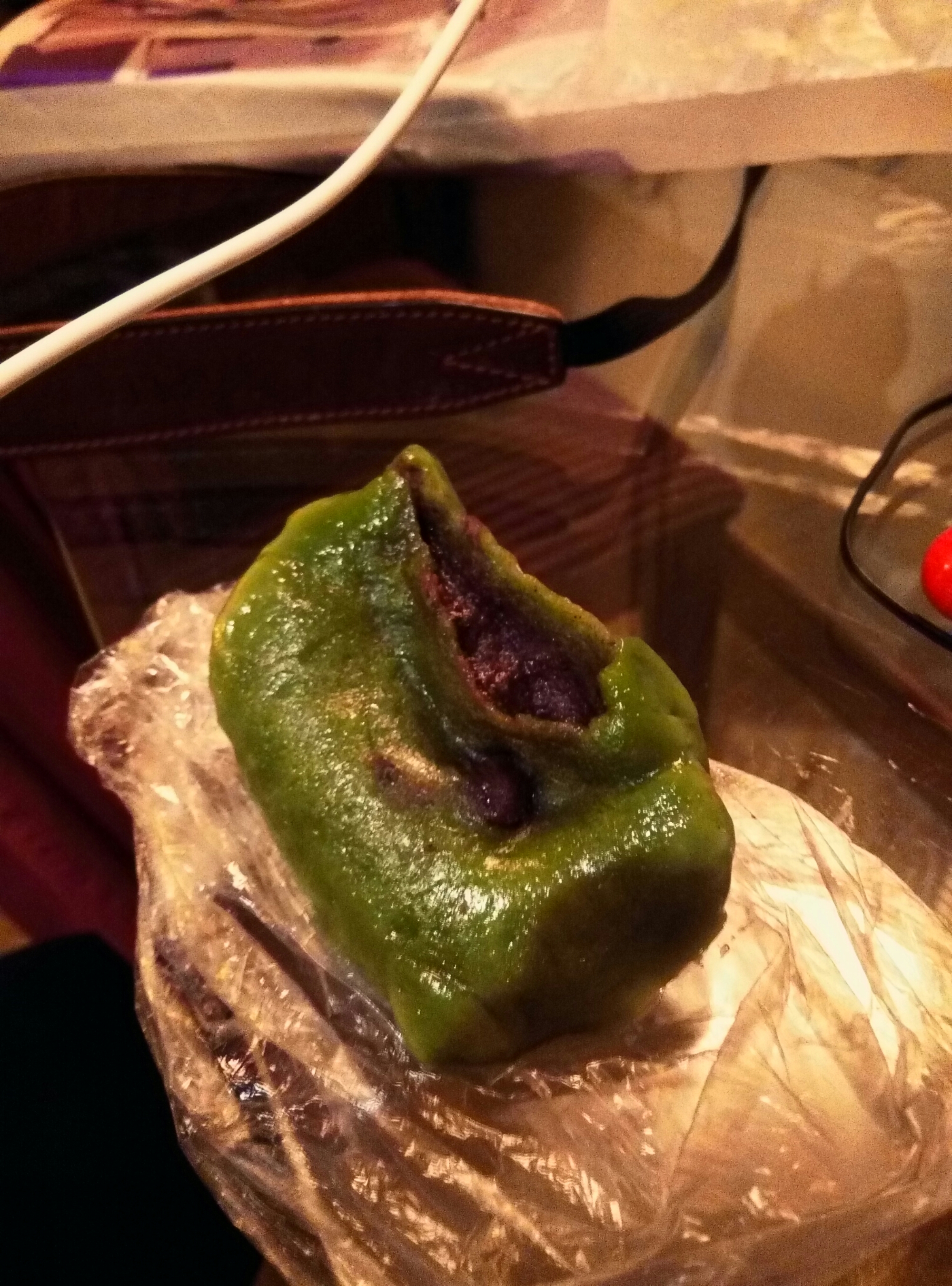
Eating in Shanghai this morningsng for the tomb sweeping festival (sort of like our Memorial Day.) They were serving Sweet Green Dumplings (青团 qīngtuán) filled with red bean paste. Only served once a year!


For the past year and a half, my oldest child has been studying at a university in Amsterdam. He’s majoring in physics and — if all goes according to plan — he should be earning his bachelor’s degree in 2017. He comes home summers and over Christmas and I visit him there at least twice a year. So far, so good. But on the heels of this morning’s news of terrorist attacks in Belgium, he said something that rocked me to my core: “It seems as though the bombings are getting closer.”
Only last November, terrorist attacks in Paris — 316 miles from Amsterdam — killed 129 people. One of those killed was a 23-year-old California State Long Beach student, Nohemi Gonzalez, who had gone to Paris for a semester of study at the Strate School of Design. Not only did her death horrify her classmates, but it also made many parents of study-abroad students wonder whether kids should still be taking college classes overseas.
Now it’s Brussels — 108 miles from Amsterdam — that’s under attack, with at least 34 people killed and many more injured today in blasts at the airport and a subway station. Only a few days ago, the suspected mastermind behind the Paris attacks was arrested.
Upon hearing of the attack, I immediately messaged my son in Amsterdam on Facebook. Although he’s alarmed — and has commented that the attacks are indeed too close for comfort — he’s not going anywhere. He’ll continue living his life and attending classes this week, just as he has been. He noted his certainty that his professors will discuss the issue today with students, just as they did in the days following the Paris attacks.
But this latest incident has given me pause, and when friends ask me what I think about whether American students should continue studying abroad, I’m no longer sure exactly what to tell them.
My husband and I raised our three kids in London, and lived there for seven years before moving to the States in 2000. I’ve long been a proponent of kids studying abroad, and even wrote an article a few months back about the advantages of getting a degree overseas. At the time, I asserted that the advantages to earning a degree abroad are many, but one of the main ones is the money saved by students and families. Many programs in Europe offer bachelor’s degrees after only three years, and often at a fraction of the price charged by U.S. institutions.
Currently, more than 46,500 U.S. students are pursuing degrees overseas, roughly 84 percent of whom are enrolled in bachelor’s or master’s degree programs, according to the most recent data from the Institute of International Education. The United Kingdom is the most popular destination, followed by Canada, France and Germany. . .

“She was free in her wildness. She was a wanderess, a drop of free water. She belonged to no man and to no city” ~ Roman Payne




Language Translation






 Deceptively Blonde