
Tag Archives: business

Understanding Simple Interest

6 Jun

As always, this lesson is not intended to be professional advice. This is simply lesson material for ESL students in a Managerial Economics and Corporate Finance class. Posted here for their use or for helping other students.

Corporate Value (值)

Financial officers and Managers are extremely responsible for the monetary (货币) goings-on in their companies. As we said before, the Wealth Maximization Rule means that Financial and Corporate Managers are required to maximize (最大化) the profits (收益) for their investors (投资者). 

However, maximizing profits requires in-depth (深入)planning and micro-managing (微观) your funds today while considering (考虑) future profits as well.

There are two types of Value (值) that you should be aware of in Finance and Economics.

The first is called Present Value (现值) and is the value today of something that will increase in value in the future. ExampleWhen we loan someone $1,000 at 10% interest, we know that our $1,000 loan will increase in value in the future.  Present Value = PV.

The second is called Future Value (未来价值) and is the value that the item will have in the future. Future Value = FV.

Interest (利)

I’ll make another post later discussing the many ways to use Present and Future value in your company, but today I just wanted to talk about using them to calculate (计算) “Simple Interest” (单利).  

Usually, when we loan money to someone or invest (投资) our money in something, we do so on the condition that we receive back more money than we put in.  Our corporation is not a charity (慈善机构), we don’t loan you things for free!  The original money we invest is called the Principal (本息).  The extra money we get on top is called the Interest (利).  

Example ~ Company A (a large global corporation) invests $100,000 in a small new business called Company B.  Company B has 10 years to pay it back. But Company A doesn’t do this for free ~ they want to maximize their profits too. That means they have to make some money on this contract (合同).  So they ask Company B to pay an additional 7% per year.   

$100,000 = Principal
7% = Interest

SIMPLE INTEREST (单利)

Problem! ~ 7% of what?  
Answer! ~ It depends 🙂   It depends on how Company A decides to count it.

There are two separate mathematical formulas (数学公式) you can use to figure out the Interest.  The first one is called Simple Interest (单利). Simple Interest says that each payment period Company B is going to pay an additional 7% of the original principal ($100,000).  The formula for Simple Interest is:

I = Interest
P = Present Value
R = Interest Rate
T = Number of Years Involved

Example

Company A (a large global corporation) invests $100,000 in a small new business called Company B.  Company B has 10 years to pay it back. The interest rate is 7% per year.   What is the Total Interest (利) you will pay over 10 Years?

Calculating FUTURE VALUE and PRESENT VALUE using SIMPLE INTEREST

The total interest is of course important to both Company A and Company B, there are two other important numbers that the financial managers of Company A want to know–the Present Value of their money and the Future Value of their money.  

Future Value

FV = Future Value (how much money you will make in total)
PV = Present Value

R = Interest Rate
T = Number of years involved

Using our example above with Company A & B, the Future Value is calculated like this:

That means Company A will make a total of $70,000 if they invest their $100,000 in Company B now. Over 10 years, their $100,000 will change into $170,000. 🙂 We like this plan!

Present Value

Sometimes, for example with bonds (债券), we know the Future Value (how much money will be paid to us in the end). But we don’t know how much money has to be invested (Present Value) to get that future result.  So Present Value is calculated by the formula: 

PV = Present Value 
PV = Future Value

R = Interest Rate
T = Number of years involved

Example: Mary Jane knows that in 4 years, she needs to have a total of $150,000 to pay her college tuition. She has an interest-generating account that gives her a 4% interest rate on everything she puts in. How much money should she invest today (Present Value) in order to have $150,000 in 4 years?

That means that Mary Jane needs to put $129,310.35 in her bank account now in order to get $150,000 in the future. 

JPEG

KEY TERMS TO REMEMBER

  1. Value (值)
  2. Present Value (现值)
  3. Future Value (未来价值)
  4. Interest (利)
  5. Simple Interest (单利)
  6. Principal (本息)

FORMULAS TO REMEMBER

Simple Interest

Future Value

Present Value
Corporate Finance – What is the Balance Sheet?

27 Apr

**As always, my work is designed with Chinese ESL student in mind. Please consider this when reading.

Corporate Finance has 3 main types of Financial Documents:

  • Balance Sheet ~ Value of the Company (How it is divided between Debt and Equity)
  • Income Statement ~ Specific Use of Assets and Liabilities
  • Cash Flow Statement ~ How Cash is Handled from the moment it enters the company until it leaves.

Balance Sheet

We all know that Revenue has to be bigger than Costs/Expenses if the company is going to be successful (Revenue – Cost = Profit). And if you are a financial manager, your legal responsibility is to increase profits for the Shareholders (earn a profit). 

However, for years all that companies worked with were Income Statements. Unfortunately many of them quickly realized they could hide money away in methods not put on the Income Statement. Not only that, but the Income Statement didn’t really outline all of the important factors used in looking at Profit.  So now we have the Balance Sheet -a financial document intended to make everything more honest and clear.

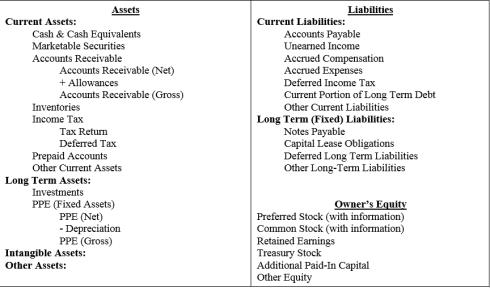
The Balance Sheet summarizes the Assets, Liabilities, and Equity at a certain date.

  •    It is an overall summary of what the company looks like. 
  •   It explains to the Business how well the company is functioning
  •   It explains to Owners how well their Equity is doing
  •   In general, it tells us if the company will be profitable or not.

For example, how much is the company worth July 2016?

General Equation (Assets = Equity – Liabilities)

  • Assets = Everything owned by the company.  Obtained by either creating capital or obtaining debts (borrowing money)
    • Current Assets –Assets that will be turned into cash within 1 Year
    • Long-Term (Fixed) Assets – Assets that will be turned into cash within more than 1 Year
    • Intangible Assets – Assets that you cannot see, but that still exist
  • Liabilities = All the debt the company has to pay
    • Current Liabilities—Debts to be paid this year.
    • Long-Term Liabilities—Debts to be paid in more than 1 year.
  • Equity (Net Worth) = Assets – Liabilities (The Company’s Value for the owners)
    • Owner’s Equity (Owner’s Investment – Owner’s Withdrawals from the Company +/- Net Income/Loss)
    • Retained Earnings
    • Net Profits or Losses


The Balance Sheet will be organized according to the “Liquidity” of the category (meaning how quickly that category of assets, liabilities, or equity can be changed into cash). The farther down the list we go, the less liquid the categories become.

EXAMPLE

Assets

Economics ~ Introduction to Managerial Economics

24 Mar

Hello-our internet sucks, so I’m posting this for some of my students 🙂 You’re welcome to enjoy it too!

What is Managerial Economics?

  • Economics (经济学)= The study of how resources (资源) are created (创造), gathered (搜集,聚集), traded (营业), and divided (分离,划分).
    • Resources = Anything you use to help the company work. Examples: time, money, land, tools, labor, raw materials.
      • Natural Resources (自然资源) = Resources created by nature. Examples: wood, water, air, rocks/stones, flowers, natural chemicals
      • Man-Made Resources (人造资源) = Resources created by humans by either combining (mixing together) or changing natural resources into something new. Examples: jewelry, paint, fabric, steel, hammers.
      • Limited Resources (限制性资源) = Resources either no longer being created or only created in small amounts. Meaning the supply is not enough.Examples: Gold, Diamonds, Water in a desert.
      • Unlimited Resources (无限制性资源) = Where there is a large amount of the resource or it is created fast enough to replace any that is lost. Supply is enough.Examples: Water, Air.
      • Raw Materials (原材料) = The resources that are put into the product. Example: If we make a computer, raw materials would include wires, plastic, metal, paint, springs, etc.
      • Market-Supplied Resources (市场提供的资源) = Resources owned by someone outside of the company. Examples = Taxes, Utilities, Rent, Raw Materials, Wages
      • Owner-Supplied Resources (业主提供的资源) = Resources owned by the company’s owners.
  • Manager (经纪, 经理) = A person who is obligated to ensure the company (or department) is effectively organized and controlled.
  • Managerial Economics (管理经济学) = The study of the best method for managers to create, gather, trade, and divide the company’s resources.

Goal of Effective Managers 

  • Wealth or Profit (收益) Maximization Rule = #1 Goal of Effective Managers is to make the owner’s the most profit (as long as they do so ethically and legally)

How to Maximize Profits (收益)?

  • Profit = Revenue – Cost
  • Two ways to Maximize Profit:
    • Make the Highest Revenue
    • Pay the Lowest Costs

What are Revenue, Cost, and Profits?

  • Revenue (收入) = Total Income or Money the Company makes from its work.
  • Cost (成本)  = The losses or sacrifices the company makes in exchange for getting and using resources in its work. 
    • Opportunity Costs (机会成本) = The company’s costs created because it lost some opportunity. 
      • Opportunity Cost of using Market-Supplied Resources = $$ Spent paying for those resources (you lose the opportunity to spend the money on something else)
      • Opportunity Cost of using Owner-Supplied Resources = $$, time, effort lost that the owner would have had if they spent their resources on something else.
    • 2 Types of Opportunity Costs
      • Explicit Costs (明确的成本) = Any money the company pays owners of Market-Supplied Resources
      • Implicit Costs (隐性成本) = Anything the Owner loses by giving the company Owner-Supplied Resources
    • Total Economic Cost = Explicit Costs + Implicit Costs 
  • Profit (收益)  = Everything the company gets to keep from the Revenue after it pays its costs!
    • Present Profit v. Future Profit
      • Present Profit = What we are keeping right now. (Most Important)
      • Expected Future Profit = What we think we’ll get in the future (Companies with higher expected future profits have more value. While companies with a possibility of low future profits will have a lower value)
    • Profit is Counted in Two Ways
      • Example: Joshua has a company (Company A) that just made $150,000 in Revenue. The company spends $9,000 on Taxes and Utilities, $3,000 on Wages, and $5,000 on Raw Materials. Joshua gave the company the building but would have made $2,000 if he used it as a school instead. He also lost $5,000 on his original investment. 
      • Economic Profit (经济利润) = Revenue – Total Economic Cost
        • What is Company A’s Economic Profit?
      • Accounting Profit (会计利润) = Revenue – Explicit Costs.
        • What is Company A’s Accounting Profit?
      • In Managerial Economics, we usually mean Accounting Profit when we say “Profit”

More to come later 🙂

New Terms Added to Corporate Governance Vocabulary

2 Feb

I’ve added new terms to the list of Business or Corporate Governance Vocabulary

Don’t forget, the Chinese translations come from the Chinese students rather than professional translators. While I believe they are accurate, you may want to consult professionals before using them for official documents. This is mainly intended to contribute to daily conversation between English speaking Companies and Chinese companies.

Abbreviations:
v. = Verb
n. = Noun
adj. = Adjective
adv. = Adverb

(c) All Rights Reserved. You are welcome to use this material. However, if you do end up using these definitions in your material (educational, informational, or professional), please include either a link to this webpage or the following reference: Blessing, Olivia. “Corporate Governance Vocabulary.” DeceptivelyBlonde.com. This is for two reasons: 1) I’d like to share the resource with others. 2) I created these definitions myself. Thanks!

Continue reading

English Translation for the Malaysian Business Registration Form

30 Sep

In Corporate Governance this semester, we are learning about International Rules of Incorporation, Bylaws, Corporate Structures, etc.  It’s actually proving to be a fairly fascinating class, and I’m enjoying watching the students work.

One of the assignments I have given them is for each group to choose a country and to complete the appropriate Articles of Incorporation paperwork for that country.  Anyways, long story short, I ended up on the SSM (government) website, which directed me to with Form A (the Business Registration form). Unfortunately, it was entirely in Malay, making it useless to my students.  So I decided to translate it!

I cannot promise you that this is an exact translation, but I believe it is pretty accurate. I hope this will help someone out!

PENDAFTARAN PERNIAGAAN BUSINESS REGISTRATION
KAEDAH-KAEDAH PENDAFTARAN PERNIAGAAN 1957 (KAEDAH 3) BUSINESS REGISTRATION RULES 1957 (METHOD 3)
NAMA SENDIRI—Menggunakan nama sendiri seperti di dalam MYKAD/MYPR sebagai nama perniagaan. Are you using your own personal family and given name as the name of the business?

Check if Yes

NAMA TRED—Menggunakan nama perniagaan yang direka atau selain nama di MYKAD/MYPR sebagai nama perniagaan Or Are you using a trade name/business name as the name of the business?

Check if yes

NO. RUJUKAN (Untuk kegunaan pejabat) NO. References (For Office Use)
MAKLUMAT PERNIAGAAN Business Information
*NAMA PERNIAGAAN Business Name
*TARIKH MULA BERNIAGA Date of Commencement of Trading (Date you begin doing business)
*PERJANJIAN PERKONGSIAN

·         TIADA

·         ADA

Partnership Agreement (Check Which One Your Company Has)

·         None

·         Yes, There is a partnership

TARIKH Date when you created the partnership (if there is one)
(Nyatakan tarikh dan lampirkan perjanjian) Specify date and attach the agreement
*ALAMAT (P.O. Box tidak dibenarkan) Address (PO Box is not allowed)
BANDAR Town
POSKOD Postal Code
NEGERI State
ALAMAT SURAT MENYURAT (Jika berlainan dari alamat di atas) Mailing Address (If different from address above)
BANDAR Town
POSKOD Postal Code
NEGERI State
NO. TELEFON Telephone Number
E-MEL Email
*JENIS PERNIAGAAN YANG DIJALANKAN Type of Business Conducted

(Describe your Business’s Purpose)

ALAMAT CAWANGAN (Jika ada, P.O. Box tidak dibenarkan) Branch Address (If so, PO Box is not allowed)

Address of Company Branches

ALAMAT (P.O. Box tidak dibenarkan) Address (PO Box is not allowed)
POSKOD Postal Code
NEGERI State
ALAMAT (P.O. Box tidak dibenarkan) Address (PO Box is not allowed)
POSKOD Postal Code
NEGERI State
*MAKLUMAT PEMILIK (Ejaan nama seperti di dalam MYKAD/MYPR) Owner Information (Spelling the Owner’s Name as in the MYKAD/MYPR (your official government ID forms)
NAMA PEMILIK Name of the Owner
NO. MYKAD/MYPR Your Government ID # (aka Passport #/SSN#/Citizenship #)àMYKAD is the identity document Malaysian citizens have
NO. K/P (Lama) Not sure what this is actually J
TARIKH LAHIR Birthdate
JANTINA L  P Gender (L or P) (Check the box)

L = Lelaki = Male

P = Perempuan = Female

KERAKYATAN Citizenship
WARGANEGARA Citizen (Of Malaysia)
PENDUDUK TETAP

(Nyatakan negara asal)

Permanent Resident (Please specify the country of origin)
BANGSA Nationality
MELAYU Malaysian
CINA Chinese
India Indian
LAIN-LAIN ((Nyatakan bangsa)) Other (State your Nationality)
ALAMAT KEDIAMAN Residential Address
BANDAR Town
POSKOD Postal Code
NEGERI State
NO. TELEFON Telephone Number
PENGESAHAN PEMILIK TUNGGAL/RAKAN KONGSI Certification by the owners/partners
(Diwajibkan setiap pemilik tunggal/rakan kongsi mengisi butiran dan menurunkan tandatangan/cap ibu jari kanan di atas borang ini) It is required that every single owner / partner fill in these details and sign or put their right thumbprint on the form.
Saya/kami yang bertandatangan di bawah mengesahkan semua kenyataan yang dibuat dalam borang ini adalah benar dan mengaku bahawa saya/kami adalah pemilik tunggal/rakan kongsi bagi perniagaan ini. I/we, the undersigned do certify that all the statements made on this form are true and that I/We are the owners/partners for this business.
BIL Number
NAMA DAN NO. MYKAD/MYPR Name and ID #
TANDATANGAN/CAP IBU JARI KANAN Signature / Right Thumbprint
TARIKH PERMOHONAN Date of Application
UNTUK KEGUNAAN PEJABAT For Office Use
Saya adalah Orang Yang Bertanggungjawab (OYB) menyerahkan butir pendaftaran perniagaan yang dinyatakan di atas I am a Person Responsible (OYB) for submittig the business registration details mentioned above.
NAMA DAN NO. MYKAD/MYPR Name and ID#
TANDATANGAN/CAP IBU JARI KANAN Signature/Right Thumbprint


Understanding Stocks and Share (Corporate Governance ESL)

11 Sep

**This is very simplified for the sake of ESL learners who are new to Corporate Governance.

Let’s pretend you want to start a corporation – you have a name and products.  But you need money.  You don’t have any money, your partner’s don’t have any money.  What do you do? The only thing you can sell for money is the company itself.  

So that’s what you do.  You decide that you will sell stocks.  What is a stock? – it is the right to claim the profit’s the company earns and the right to decide what the company does.  Now let’s say you divide the stock into 1000 shares – what is a share? – it is a small piece of paper saying you own 1/1000th of the stock – you get 1/1000th of the profits and you get 1 vote of a 1000 possible votes deciding what the company does.  In return for owning your share of the stock, you give the company money so that it can develop and grow.  To prove that you own the shares, when the corporation begins, it gives the owners, or shareholders as they are called, stock certificates – the papers we were filling out in class (basically fa piao or official receipts)

One person can buy more than one share – the board will decide a certain price for each share (i.e. $1 per share) and you can own as many shares as you pay for.  So let’s say I decide to pay $500 = I get 500/1000 shares = my vote will be counted 500 times and I will get 50% of the profits.  In most family-run corporations, family members will own 50-90% of the shares so that they control the majority of the votes and make most of the profit. If they own less than 50% of the shares, the other owners can out-vote them and make decisions for the company that the family doesn’t want.  This is a problem, so families are very careful to avoid that risk.  

The board has to think about this when starting the corporation because they will have to be careful about who holds power over the profits and votes.  Remember the agency relationship – the shareholders or stock-owners are the principals, the board is the agent – the shareholders can always vote to remove or change the board, but the board cannot replace owners they don’t like. Basically, the original board of directors chooses their owners by selling them shares, but once they do that all power goes to the new owner.   

**Note that the number doesn’t have to be 1000, the bigger the company the more shares will be available for purchase.

Chinese Student Finds Niche Market for Feminine Pads

17 Sep

Wow, as a teacher here in China, I have had a lot of fun watching the cute freshmen run around for training.  But I have to agree, it is a foot problem waiting to happen.  Go Li Yuan!  You deserve a business award for 1. great idea and 2. good business sense.  I’m impressed. **DB


Chinese Student Finds Niche Market for Feminine Pads

by Nancy Z via “DramaFever

A college student in China has found a niche market for feminine pads. It is a funny story, but we can also learn some business lessons from a budding young entrepreneur who identified a problem and found a solution.

(photo whxy.swu.edu.cn)

All Chinese college students must endure a type of military boot camp training in their first year in college. It’s like a strenuous PE class where they go through lots of physical activities like trekking and jogging. An effect of such activities is what happens when you put young men’s feet and sweaty socks together. Yes, strong odor.

Lesson #1 – Be observant.

Enter Li Yuan, a third-year student at the Southwest University in Chongqing, China. He figured out that putting a feminine pad in a shoe can absorb moisture and prevent odor. Actually, he didn’t come up with the idea originally. He saw a few male students looking shy while standing near the feminine pads aisle at a supermarket. He was curious and learned from the manager that these students were buying the pads for use at the boot camp sessions.

Lesson 2 – Identify the problem.

The problem is actually two-fold as many new college students don’t even know that they’ll benefit from the feminine pads and that many male students would find it embarrassing to shop for the feminine pads out in the open.

Lesson 3 – Decide on a solution.

Li realized where there is a demand, he can provide the supply. He decided that he would become a personal shopper and sell the feminine pads directly to the students in the comfort and privacy of their dorms.  . . . .

READ MORE


Classes Free!

17 Sep

Wow! Check out what Wharton College is doing with their MBA program’s classes!  You can find the article here.  They’re offering the first year (and apparently a couple other courses) online for free, helping those people who cannot afford the degree or who can’t take the time for a whole program.  While I’m sure this will help MBA-interested people; I’m even more excited about what it will do for all those small business owners. You know, the people who really studied design, photography, English, etc. and who don’t want a whole MBA program since most of their work is in their field of art/electronics/etc. not in running the business But if you have a small business, knowing the basics can be a lot of help in simplifying everything.  This is going to be such a great tool for them!  

Video

Adding Products to your Amazon Store

13 Feb

I’ve recently started a new literary blog for several authors to join, and I’ve been trying to figure out how to best explain adding products to Amazon aStores. I finally ended up just making a video explanation, and I thought I would share it here! Hope this helps someone else out!

Also check out Shelfari.com –A better bookshelf for literary bloggers to use!

By the way, my new website it “A Question of Reading” and is available here.  Check it out if you’re interested in reviews, articles, literary criticism, and more!