#Art I Love ~ The #Buddhist Goddess of Mercy

1 Jun

Obtained from ThaiYogaUp.com. Original Artist – I’m Not Sure

The Goddess of Mercy in Chinese Buddhism is named Guanshiyin  (观世音菩萨 — Guān shì Yīn Pú Sà) or Guanyin for short.  The name means “one who always hears the cries of the world. While many of the Buddhist deities are rather frightening (as seen in their paintings and depictions), Guanyin is actually very highly respected for being merciful to her followers. 

There are many legends surrounding the lovely lady.  Apparently, the original story (stemming from India) had her as a man called avalokitasvara. He was extremely kind and worked non-stop reaching out to those who cried out for help.  Some actually claim he was the most powerful of all the Buddhist gods, and certainly most agree he was the nicest. It wasn’t until the Song dynasty (960 – 1279) that the deity was changed into a woman. The Indian name was translated into Guanyin, and the uniquely Chinese feminine version was born to become mother to the world. 

In China, the story is that she was a human who eventually became immortal through her good deeds and worthy heart.  According to one story, she was holy and kind enough to find herself at the gate of Heaven. But, upon hearing the weeping and tragic cries of sorrow and pain from those suffering on earth, her heart was moved. Turning back from her place in the joyous realm, she returned and devoted herself to helping those in need. Thus her name — she always listens to and helps those who call out to her. 

Another story comes from 827-840AD (the Tang Dynasty) in the city of Xi’an.  According to the legend, the Emperor at the time was a man called Wenzong.  Now, Wenzong had the unfortunate love of clams, asking from clams day after day, three meals a day! But, if you’ve ever lived in Xi’an, you would know that it is very far from the sea–so clams were hard to find.  And of course, he was not happy with any clams – they had to be fresh and delicious! So, every day before the light came up, the poor fishermen in Zhejiang’s ports would collect up clams and rush them inland.  Then, finally a miracle happened! One of the clams they found was HUGE (20x the normal clam size).  All agreed, this clam must absolutely go to the emperor.  But when they tried to open it, they found that the clam was shut up and would not budge. When he heard of this strange even, the emperor himself came to see it. At last! Right before his eyes, the clam shell opened and inside was an elaborate carving of Guanyin.  Looking into the statue’s eyes, he heard her beautiful voice echo in his ear — “These poor workers have sacrificed much to satisfy your simple pleasures. You are abusing your people and wasting their money.”  The people had prayed for someone to save them from the painful, meaningless labor and the goddess had responded. The emperor learned his lesson!

As a Buddhist deity, she seems to be an all around lovely person. She is known for reaching out to those who are ill, lost, abandoned, elderly, orphaned, and just generally in a tough spot.  She is recognized for having eternal, unending love for people and the kindest of hearts.  She is often a fertility goddess who gives children to those who need them.  Always there to help, she is the supporter and defender of the unfortunate.  She also helps guide the lost and missing, and has become one of the “sailor’s” deities. The fact that legend has her living on an Island in the South of China has contributed to this theory — thus the frequent depiction of her with pearls from the ocean or rising from a shell or lotus blossom like Venus. Even here in Xinzheng, Henan we have a statue of her–you’ll find them scattered all over China. I’ve been told both the Shaolin Temple (China) and Kiyomizu-dera (Japan) are dedicated to her. 

Image may contain: 1 person, standing and outdoor

My good friend Harry in front of a Statue of Quan Yin in the Zheng Garden.

Most images of Quan Yin show her in bare feet with ancient Chinese-style thin, blowing in the wind kind of clothes.  They always bring to mind the lovely ladies of wuxia (Chinese historical) dramas or the old films. Lithe, graceful, elegant — an all around perfectly kind, beautiful, and gracious woman inside and out.  Usually, the pictures show her alone or with two other people. Sometimes she has a child in her arms. At other times, it is two soldiers who defend the faith. The first is general Guan Yu, a real man made famous in the fictionalized story “The Romance of the Three Kingdoms.” Honored for being very loyal and virtuous, he is still prominent in the Buddhist faith. According to the believers, he not only fought of enemies of the country, he defended the righteous from demons as well. The second is Wei Tuo, a young prince who proved faithful to Buddha by protecting the holy relics. Together they stand guard as the goddess works her wonders. 

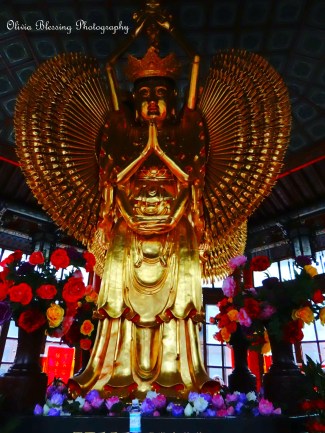
Sometimes you’ll see the goddess of mercy in a different way, with several heads and hundreds of arms.  There are several versions of the story as to why she has so many arms and heads. You can read one version here.  Another version says that she dedicated her life to helping people in need, promising that she would not stop until she had helped everyone. Eventually, she realized that no matter what she did, there were still too many people. Frantically thinking about all that was left to be done, her head finally exploded into eleven parts.  Concerned, one of the buddhas came to help her and ended up offering her eleven heads to hold the eleven parts.  But now, hearing the cries so much better with her 22 ears, she became even more upset–pulling herself in many directions trying to read everyone at once.  Reaching. . . reaching . . . finally her arms just shattered.  Again the buddha reached out to the poor, good-hearted goddess and offered her one thousand arms to hold all those pieces so she could help more people.  Thus the statue in Kaifeng has 1000 arms (although they follow the first version of the story instead of the second)!
Mercy

The Goddess of Mercy statue in Kaifeng, Henan
Whistling Through the Vines

1 Jun

DSC04500

The province of Henan resides in central China, and is home to the largest population here. Although the modern day center is the famous Beijing, China’s history has to a large extent actually centered around Henan itself. Of the six ancient capitals in the country, three of them are in Henan.  If you’ve ever watched some of the popular Chinese martial arts films, you will have heard the names “Luoyang,” Kaifeng,” and “Shaolin Temple.”  I now can proudly say I’ve been to all these places and more! At this point, I’ve visited:

  • Anyang
  • Xinyang
  • Nanyang
  • Pingdingshan
  • Zhoukou
  • Zhumadian
  • Zhengzhou
  • Xinzheng
  • Kaifeng
  • Luoyang

and more! 

This past weekend, I got the opportunity to add a new city to my list — Gongyi (巩义市).  Gongyi is a small city about 1 hour from Zhengzhou (the capital).  On one side you have Mount Song and many hills (beautiful!). On another, it is bordered by the Yellow River, one of the 2 most famous in China. 

Image result for Gongyi map

The entire trip for us was planned by the Henan Tourism Organization (the provincial tourism committee), so we didn’t actually have to pay for anything. However, the cost wasn’t bad at all even if you did pay.  

DSC04487

The bus ride up there costs about 10RMB ($1.50) and was extremely interesting just on its own. We passed the lovely shrine/temple shown above (I’m not exactly sure what that was – we didn’t stop), but even more awesome were the hundreds of Cave Homes we passed!  Here in Gongyi, many people actually still live in caves dug into the cliffs surrounding the area.  Although most westerners think “oh poverty!”, this isn’t actually true.  A lot of these homes are really nice and awesome!  They have running water and electricity, drive up roads, yards and gardens in the front, elaborate front doors, etc.  They are really nice, just inside a mountain. I wasn’t able to get excellent photos since we just drove past them, but sometime I want to go back. 

When you arrive in the city, you’ll see a lot of things dedicated to DuFu (杜甫). DuFu lived in the Tang Dynasty (700s) and is considered perhaps China’s best poet!  According to the Chinese, he was born here and is still revered as seen through the statues and monument decorating the city.  According to the tour guide, the Chinese consider him the #1 literary person to know and he has often been considered the “Chinese Shakespeare.” His ancestral home is here too!


SONG TOMBS

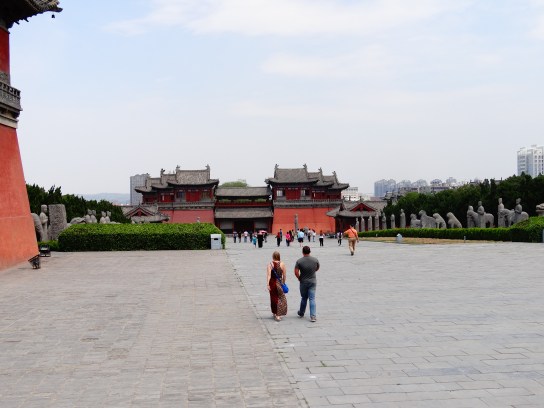
Once we arrived, we had a small trek to our restaurant so we walked through the Imperial Mausoleums of the Song Dynasty (960-1279).  Also called the “Song Tombs”, this area is where all but one emperor of the North Song Dynasty are buried.  They include Tai Zu (Zhao Kuangyin), Tai Zong (Zhao Guangyi), Zhen Zong (Zhao Heng), Ren Zong (Zhao Zhen), Ying Zong (Zhao Shu), Shen Zong (Zhao Xu) and Zhe Zong (Zhao Xu).  🙂 

This part was free (it’s just a giant city part area where you can walk around) and was huge for a city park. A great place to take your kids for a picnic! Up towards the tombs themselves are a long row of stone statues that were really interesting. 

DSC04516DSC04511


After lunch, we got back on the bus and took about a 20 minute ride to the Kang Mansion (Kangbaiwan – 河南巩义康百万庄园).  “Baiwan” means Millionaire, so this is the home of the Millionaire Kang family.  Considering that they lived hundreds of years ago, that’s a pretty big claim!  


The family originated with Kang Ying-Kui in the Ming Dynasty, and its fame lasted more than 400 years (that’s 13 generations!).  According to a monument inside, the family was famous not only for its wealth, but also for its honor. The monument is a plaque written by an emperor honoring the Kangs for having 8 generations of “good, noble, honest sons.”  Apparently, they were loyal, fair, honest, and not corrupt–well worth honoring!

DSC04613

Kang Ying-Kui came to fame by suppressing Bailianism (a so-called the White Lotus Religion– mixed Buddhism with Taoism and worshipped a goddess Wusheng Laomu).  The group didn’t fit in with the accepted religions of the time and allowed men and women to “interact in a shockingly free manner.” 😛 (Apparently they brought a bunch of “groups” together and were a threat of rebellion.  Anyway,  the Kangs were really fashionable and already pretty rich from their own business (river transportation and agricultural products).  There was some sort of phrase like “if you travel 1000 miles you’ll still be on Kang property).  This brought them to the notice of the royal family who helped raise them up even further. 

DSC04619

Inside, there are 19 different parts and about 65,000 square meters.  There are 53 multi-story buildings, 97 “bungalows,” 73 cave homes, and approximately 570 rooms in total.  It was built in the 17th – 18th centuries (1600s-1700s), and the architecture is in the form of the North China “Loess plateau” style.  Basically, that means it was in the era’s feudalistic form (many small buildings with hundreds of carvings and art in the wooden, brick, and stone beams.  It follow strict formality and traditionalism–“building face the street, ports on the river, cave dwellings in the mountains–everything according to its place and order.” In the 1960s and 1970s, their home was one of the 3 largest in China–today it’s the only one of the three that is open to the public. 

Admissions: 30RMB (about $4.50)

Anyone 60 years or older get 1/2 their tickets (I think?).  People 70 years or older aree free.  Full time students can have 1/2 price and children under 1.4 meters are free. People with disability cards are free, as are servicemen and disabled veterans. 

Opening hours: 8:00-18:30

Transportation
2. Take NO.11 bus in Gongyi city to terminal station (1 Yuan) and then transfer to Kangdian town by minibus (1 Yuan).
 
Website: Here

Gongyi Grottos

DSC04814

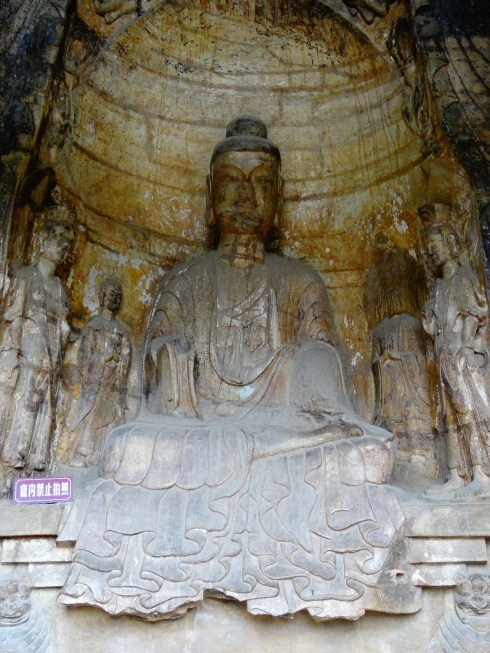
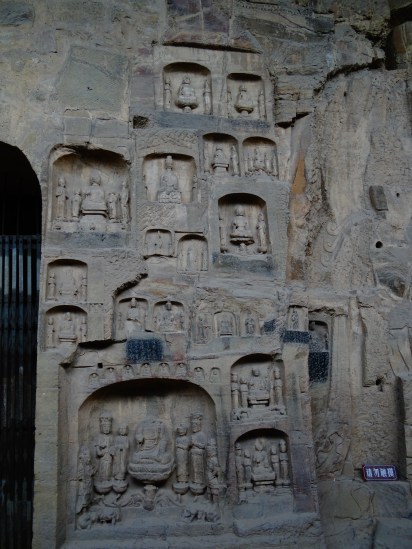
Fabulous! The Gongyi Grottos is a Buddhist temple created around the Northern Wei period of 479-499 AD.  The statues though are as old as 384 – around the 600s AD.  There is the nearby Longmen Grottos in Luoyang, but the Gongyi set is somewhat more well preserved (although not quite so large). 

DSC04851

To be honest, a lot of the younger people were quickly bored here — but as a historian and cultural student, I found the place truly fascinating.  They have one very elaborate, colored and painted temple area with a tall statue surrounding by the various Buddhist deities on either side.  All set in beautiful painted depictions of myths and stories. 


All in all, it was a lovely day full of awesome art, history, and culture. My favorite kind of trip!

#Door to the #Past

31 May

There were a few hundred of these lovely doors (each painted a different way on top). The middle class and nicer neighborhoods in town are still in the old kinda #Traditional style with a big front Door to the courtyard and small rooms for the Family off the center. Very Awesome!  And Beautiful artwork!

Life in #China – Happy Dragon Boat Festival!

29 May

Happy Dragon Boat Festival!  Today in #China we are celebrating the Duanwu #端午 festival!  It’s been a Holiday here for more than 2000 years!

It celebrates the Famous #poet #quyuan. Devoted to #China 🇨🇳, he wrote beautiful poems about its history, nature, and people. When the invading Qin armies approached, he chose to drown himself rather than see his beloved country fall.  Although they sent out many #dragon boats to look for him, they could not save him in time. 
 So to commemorate his memory, every year they eat  #粽子 (aka Zongzi), a sticky #rice #treat wrapped in banana leaves. And the big cities send out Dragon #boats for big battles and races on the lakes and rivers! Cool!

#Foodie! Stewed Iron Eggs

29 May

​Stewed Iron Eggs – everypne’s favorite food! It even comes #SPICED! As my ESL students say – ‘have a try!’

Notice the star #anise on the picture (tastes like licorice – often poisonous here in #China since the legit anise stars go to theraflu factories).  Can only imagine that added to stewed egg flavor!

Life in #China – #WeChat 

28 May

#Tigger is here

27 May

Holy tigger,  I love this – Our university art students are encouraged to paint the man holes aroind campus as projects. This one showed up today! ❤

#Business Vocabulary ~ #Economies of Scope and Scale

27 May

As always, this lesson is not intended to be professional advice. This is simply lesson material for ESL students in Business, Economics, and Finance classes. Posted here for their use or for helping other students.

Unlike Short-Term (短期) Planning, Long-Term (长期) operates on different goals (目标), strategies (战略), and analyses (分析).  

Business.jpg

Two common goals are very important: Economies of Scale and Economies of Scope. Continue reading

How Far Has the #BarExam Fallen

25 May

Comparison with February 2013 scores.  ** Please note that all 2017 passage rates are still more or less unofficial. A few states each year will change the rates before the ‘end-of-the-year’ report by the NCBEX because of people who were re-counted, finally passed some previously uncompleted portion, etc. Or (as with Maine and Kentucky), they tell us how many people registered for the exam, but not how many actually took it.  But in general these numbers are pretty reliable. Even when the rates do change, they normally change by less than 2-3%.  This year, the only one I’m really unsure how much the change will be is Maine. It is changing over to the UBE in July, and it is possible a lot of registered applicants skipped the Feb. exam in favor of the UBE upcoming.  For the other states, I’m think they are pretty reliable. 

Unknown (No 2017 Stats Posted)
Down 1% – 10%
Down 10% or More
Up
Unchanged

  • Alabama (Down 6%)
    • 2013 ~ 47%
    • 2017 ~ 41.3%
    • Sitting at 41-42% for 3 years now.
  • Alaska (Down 1%)
    • 2013 ~ 65%
    • 2017 ~ 64% 
    • For 5 years now ~ even years it goes up, odd years down to 64-65%. VERY Unstable (64% – 77% – this is the lowest so far since 2013)
  • Arizona (Down 15%)
    • 2013 ~ 66%
    • 2017 ~ 41%
    • Going down every year by a large #.
  • Arkansas (Unknown)
    • 2013 ~ 61%
    • 2017 ~ Currently Unknown
    • Varies between 61-65%. Last year sharp drop to 51%
  • California (Down 7%)
    • 2013 ~ 41%
    • 2017 ~ 34.5%
    • Has been dropping steadily since 2014.
  • Colorado (Down 7%)
    • 2013 ~ 69%
    • 2017 ~ 62%
    • Fell to and has been holding steady at 61-62% since 2015.
  • Connecticut (Down 22%)
    • 2013 ~ 72%
    • 2017 ~ 50%
    • Falling steadily since 2014.
  • Delaware (No Exam in February)
  • DC (Down 1%)
    • 2013 ~ 47%
    • 2017 ~ 46%
    • Except for 2015, DC has held steady at 46-47%
  • Florida (Down 10%)
    • 2013 (67%)
    • 2017 (57%)
    • Very Unstable, ranging from 45% (2016) to 73% (2014) 
  • Georgia (Down 15%)
    • 2013 ~ 66%
    • 2017 ~ 51%
    • Falling steadily every year since 2013
  • Hawai’i (Unknown)
    • 2013 ~ 66%
    • 2017 ~ Unknown
    • Fell from 2013 to 2015, then jumped 10% in 2016 to 73% passing. Not sure if the upwards or downward trend will continue.   In 2016 it was 73%, but in 2015 it was 62%.
  • Idaho (Down 6%)
    • 2013 ~ 75%
    • 2017 ~ 69%
    • Falling steadily every year since 2013
  • Illinois (Unknown)
    • 2013 ~ 75%
    • 2017 ~ Unknown
    • Falling steadily since 2014 (and 2014 and 2013 were the same 75%, so basically it’s fallen since 2013).  In 2016, it was 63%
  • Indiana (Down 21%)
    • 2013 ~ 69%
    • 2017 ~ 48%
    • Up and Down from 2013 – 2015.  Falling sharply in 2016 (down 12%) and 2017 (down another 7%).
  • Iowa (Down 6%)
    • 2013 ~ 75%
    • 2017 ~ 69% 
    • Falling steadily since 2014.
  • Kansas (Down 24%)
    • 2013 ~ 90%
    • 2017 ~ 66%
    • Fell steadily from 2013 to 2015.  Then in 2016, fell sharply by 25% to an overall rate of 56%.  Then in 2017 went back up to 66% (still much lower than 2015).  
    • In summary, my guess is it’s still going down next year. 
  • Kentucky (Unknown*)
    • 2013 ~ 74%
    • 2017 ~ Unknown
    • **Looks bad this year. Comparing only applicants to passers (no idea how many simply didn’t take the test), passage rate of 49.5%. But I don’t expect the number to be too different, since it’s the same exam as normal for Kentucky.
    • In 2016, the rate was 78%. It’s been sitting at around 74% – 78% from 2013-2016, so I’d expect it to return to that range. This year was a bit of a surprise and concern. 
  • Louisiana (Up 19%)
    • 2013 ~ 41%
    • 2017 ~ 60% 
    • Steadily rising from 2013 to 2016.  But this year (2017) it fell 6% which raises concerns it will start the downward trend now.  Not sure what to expect.
  • Maine (Unknown)
    • 2013 ~ 68%
    • 2017 ~ Unknown
    • Unofficially (comparing only applicants to passers) the rate is 32.2%.  But Maine is changing to the UBE in July, so I’ve been told a lot of people who registered ended up not taking it.  Usually the rate has been between 59-60% and I’d expect it to go back around there. 
  • Maryland (Down 5%)
    • 2013 ~ 63%
    • 2017 ~ 58%
    • Bouncing up and down between 47% and 63%. Been in the 50%s for 3 of the last 5 years.
  • Massachusetts (Down 16%)
    • 2013 ~ 63%
    • 2017 ~ 47.8%
    • Falling steadily for 5 years.
  • Michigan (Unknown)
    • 2013 ~ 62%
    • 2017 ~ Unknown
    • Been bouncing between 58% and 65% falling mostly in the 62-65% range.  
    • In 2016 it was 65%
  • Minnesota (Down 19%)
    • 2013 ~ 71%
    • 2017 ~ 52%
    • Falling by about 10% every 2 years.  This was the steepest drop so far though. 
  • Mississippi (Down 30%)
    • 2013 ~ 66%
    • 2017 ~ 35.7%
    • Went up in 2014, then has been falling ever since.  This still was a REALLY sharp drop from 2016’s 65%.  So I’m expecting it to go back up to around 55%-60% next year.
  • Missouri (Down 17%)
    • 2013 ~ 82%
    • 2017 ~ 66%
    • The scores have been falling steadily every year. If it follows the previous patter of the last 5 years, it’ll be around 61% maybe for 2018? 
  • Montana (Down 30%)
    • 2013 ~ 81%
    • 2017 ~ 51%
    • It fell by 14% in 2014, then went up again about 7% in 2015. Since 2015, it’s fallen by quite a bit each year. 
  • Nebraska (Unknown)
    • 2013 ~ 62%
    • 2017 ~ Unknown
    • Sharp drop to 43% in 2014, but since then it’s held steady at 59%.  In 2016 it was 59%
  • Nevada (Down 6%)
    • 2013 ~ 54%
    • 2017 ~ 49%
    • Went up until 2015, then started to fall ever since.
  • New Hampshire (Unknown)
    • 2013 ~ 57%
    • 2017 ~ Unknown
    • Scores keep bouncing, very uncertain. Ranging from 56% to 75%. In 2016, it was 64%
  • New Jersey (Down 18%)
    • 2013 ~ 59%
    • 2014 ~ 41%
    • Falling steadily since 2014.
  • New Mexico (Down 18%)
    • 2013 ~ 85%
    • 2017 ~ 67%
    • Falling steadily every year since 2013
  • New York (Down 6%)
    • 2013 ~ 50%
    • 2017 ~ 44%
    • Falling every year until 2016 (40%).  Then rose this year back up to 44%)
  • North Carolina (Down 13%)
    • 2013 ~ 49%
    • 2017 ~ 36.7%
    • Falling steadily since 2014.
  • North Dakota (Down 24%)
    • 2013 ~ 63%
    • 2017 ~ 39%
    • Falling every year since 2013.
  • Ohio (Down 16%)
    • 2013 ~ 67%
    • 2017 ~ 51%
    • Falling since 2014.
  • Oklahoma (Up 4%)
    • 2013 ~ 77%
    • 2017 ~ 81%
    • This was unexpected. For the last three years, the passage rate has sat at 67-69%. Then suddenly in 2017 it jumped up to 81%. I actually expect it to fall back to 65-69% next year.
  • Oregon (Down 2%)
    • 2013 ~ 69%
    • 2017 ~ 67%
    • Falling steadily through 2016 (60%). Then jumped back up to 67%. Not sure, but I expect it to go down a little bit next year. 
  • Pennsylvania (Down 7%)
    • 2013 ~ 61%
    • 2017 ~ 54%
    • Bouncing a bit, but slowly falling overall.  Might go up a few % next year and then fall some more the year after.  Kind of uncertain.
  • Rhode Island (Down 10%)
    • 2013 ~ 55%
    • 2017 ~ 45%
    • Falling significantly since 2014.
  • South Carolina (Down 13%)
    • 2013 ~ 73%
    • 2017 ~ 60%
    • Going up and down, but downward overall. Since it went up in 2017, I’d expect it to fall in 2018.
  • South Dakota (Unknown)
    • 2013 ~ 76%
    • 2017 ~ Unknown
    • Going down a lot overall, ranging from 76% (2013) to 26% (2015).  In 2016 it was 43%.
  • Tennessee (Down 13%)
    • 2013 ~ 59%
    • 2017 ~ 46.8%
    • Falling steadily since 2014
  • Texas (Down 26%)
    • 2013 ~ 74%
    • 2017 ~ 48%
    • Falling steadily since 2013
  • Utah (Unknown)
    • 2013 ~ 77%
    • 2017 ~ Unknown
    • Rising generally, but fell in 2016 by 14%.  In 2016 it was 66%
  • Vermont (Down 31%)
    • 2013 ~ 83%
    • 2017  52%
    • Erratic. Fell to 47% between 2013 – 2015. When up in 2016 to 61%. Then back down in 2017 to 52%.
  • Virginia (Down 4%)
    • 2013 ~ 57%
    • 2017 ~ 53%
    • Pretty steady around 57-59%. Not sure why so low this year.
  • Washington (Steady)
    • 2013 ~ 58%
    • 2017 ~ 57.8%
    • Had a high in 2014 (70.9%) but has since been falling steadily to below 2013 levels. Expect it to keep falling in 2018
  • West Virginia (Down 10%)
    • 2013 ~ 62%
    • 2017 ~ 52%
    • Falling Steadily each year through 2016 (51%). Went up 1% this year to 52%, but expect it to probably stay around the same 50-53% next year or fall again.
  • Wisconsin (Unknown)
    • 2013 ~ 85%
    • 2017 ~ Unknown
    • Falling steadily since 2013. Was 56% in 2016.
  • Wyoming (Unknown)
    • 2013 ~ 82%
    • 2017 ~ Unknown
    • Erratically bouncing between low 80% and mid 60%.  Since it was 62% in 2016, I’m betting it was a little higher for 2017. Then will be lower in the 60%s again for 2018.  

Don’t #Fence Me In!

25 May

DSC04904

Chinese historical sites (and some city buildings) here in Henan have a tendency to have these sharp warnings NOT to climb the walls.  Given how much looting and destruction they’ve faced with their heritage in the past, it is a pointed (pun intended) reminder that history is to be protected, not stolen or broken.  Also – avoid the Baiju (China’s alcoholic beverage which is as much as 70% alcohol). Getting drunk on that and stupidly climbing the fence is a REALLY BAD idea here!